The Dutch opinion is clearer than varying evidence
The NHG Explanatory notes to the revised standard Epicondylitis does not recommend referral to shockwave therapy. Thuisarts lists shockwave among treatments that are not recommended. That advice deserves a clear place on a website about shockwave.
A formulation if the effect is different per person is too weak here in itself. This sentence may give the impression that a treatment is proven useful, but sometimes it does not work. The Dutch recommendation is more reluctant: the justification does not justify a standard application to a tennis elbow.
This does not exclude that people experience improvement after treatment. It means that such experience does not sufficiently show how much improvement was achieved by the technique itself and whether that choice adds on average enough.
Why an improvement afterwards doesn't prove enough
Tennis elbow can improve over time. At the same time, people often change their work, sports or way of lifting. When shockwave coincides with those changes, you cannot determine from one personal course which part was responsible.
Research tries to distinguish this extra effect with a comparison group. It is important what both groups received further: explanation, exercises, other treatments or adjustments. An improvement within the treated group is a different outcome than a convincing difference between the groups.
That doesn't make a personal experience worthless. She tells how someone experienced a journey. It alone cannot prove general effectiveness. Therefore, ask at a success rate on which it is based, how success is defined and whether people who stopped or did not come back have been taken.
A positive study should fit your question
Not every study investigates the same group. The duration of the symptoms, previous treatments, used technique and comparison treatment may vary. The result and the moment of measurement also matter.
Ask whether the research is really about tennis elbow. A good result in heel pain or shoulder calcification cannot be taken directly to the elbow. The same applies to other equipment or to a combination of treatments where it remains unclear what each part did.
Moreover, a statistical difference does not automatically mean that the difference is large enough to be important in everyday life. For you, holding an outcome like tool again can be more relevant than a slight change on a pain scale. Let the clinician make that translation explicit.
So what's a logical starting point?
NHG emphasises explanation, appropriate reduction of the incriminating activities and pain treatment when needed. That is an active policy with agreements, not an order to wait endlessly without help.
Discuss what task the problem is. Is that heavy lifting, prolonged grabs, repetitive work or the combination of work and sport? A viable adjustment should fit your real week. General advice such as slow down are often not concrete enough.
Guidance can have a role in selected situations, for example when arm use remains difficult or you have a lot of fear of moving. Then ask which practical problem helps the guidance solve. Also exercises should not be sold as guaranteed accelerated healing if the justification does not support it.
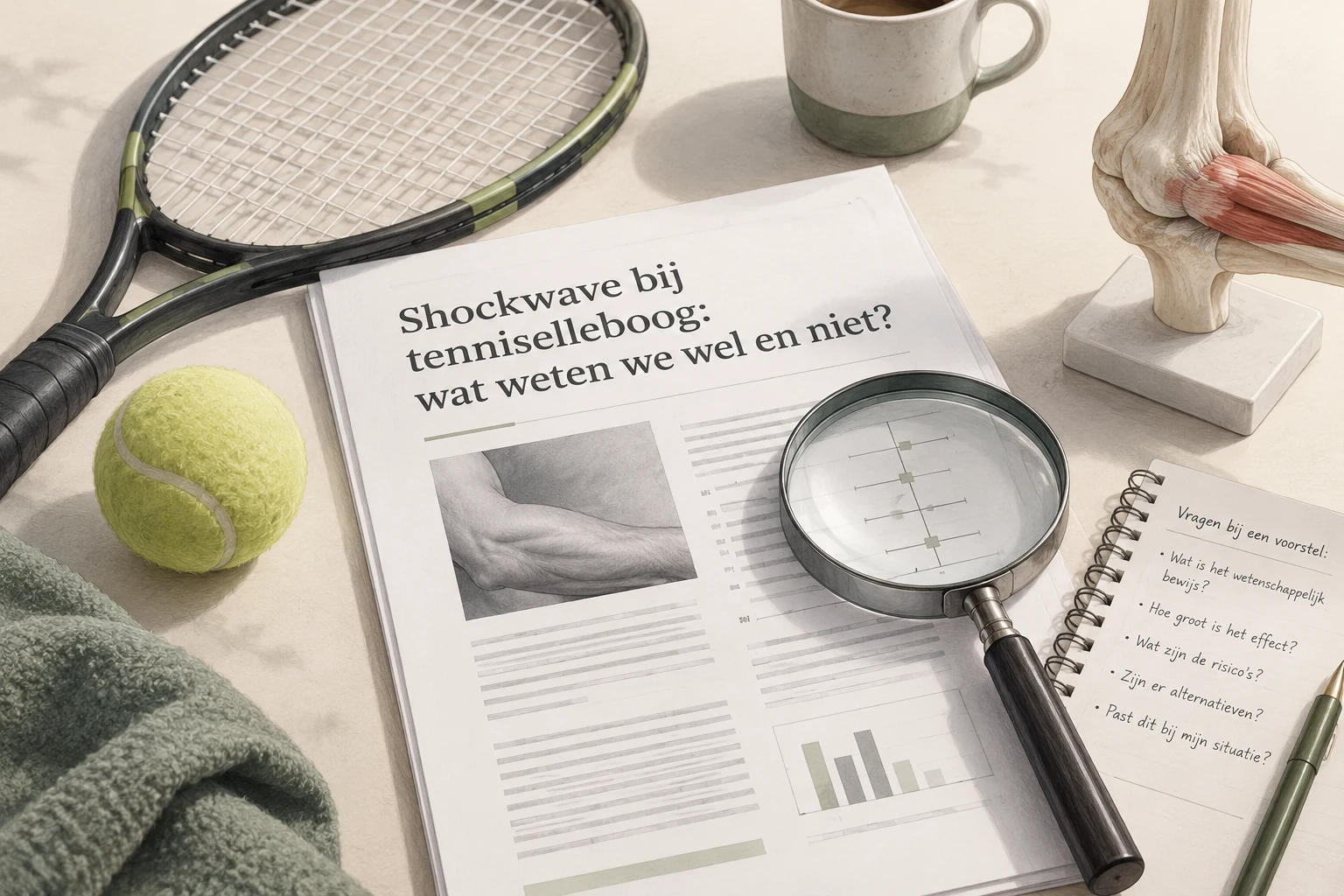
Five questions on a shockwave proposal
Use this as a call help when the treatment is proposed.
- What findings support the diagnosis of tennis elbow?
- Why is there a deviation from the Dutch general practitioner advice?
- What research shows relevant additional profits in comparable people?
- What are the disadvantages, costs and alternatives discussed?
- When will we be evaluated and on what grounds will we stop?
A careful answer may contain uncertainty. A less useful answer moves attention solely to the power or modernity of the device. A technical feature does not prove clinical added value.
For example, you are most affected by a daily job. Then a proposal should explain how the task, assessment and possible treatment are related. Booking only multiple sessions leaves the most important question open.
If you have to look beyond the existing diagnosis
If the symptoms become different, re-assessment is more important than automatically adding a new treatment. Think of tingling, a clear stretch limitation, swelling or decreasing function. Thuisarts mentions such changes as reasons for contact with the general practitioner.
Also ask for re-evaluation if the trajectory is constantly extended without anyone discussing your goals again. What other clues do the original statement support? What's been well tried? What uncertainty remains?
You may decide not to follow an offered treatment. A decision to first clarify the diagnosis or the load plan is full. The name of a centre or the presence of equipment shall not determine that every visitor receives the same therapy.
Frequently asked questions
NHG doesn't recommend shockwave at tennis elbow?
Yes. The explanatory note to the revised standard explicitly mentions that reference to shockwave therapy is not recommended. Thuisarts joins in. This should be clearly stated in the information, even if a clinic does use the technique for other conditions.
Why am I hearing that shockwave helped someone?
An individual experience can be positive, but does not show what additional contribution shockwave made. symptoms, customized activities and other care can play a part at the same time. A general treatment choice requires comparative studies and their overall assessment.
Has focused shockwave been proven at tennis elbow?
Each technique needs its own supporting evidence. Calling a treatment focused shockwave does not remove the Dutch recommendation against its use. Ask which comparative evidence supports the proposed treatment and why it would justify departing from the guideline.
What do I ask if I'm already on a trajectory?
Ask what purpose is being followed, what change is noticeable and what the stopping criterion is. Also discuss the guideline opinion and any disadvantages. Continuing doesn't have to be automatic because you've already started; a new consideration can be careful.
Sources and evidence
- NHG: revised standard Epicondylitis ↗
Explicitly do not recommend referral shockwave; explanation, activity reduction and selective additional care.
- Thuisarts: I have a tennis arm (2025) ↗
Recommendation against shockwave, with context on the natural course, advice and reassessment.
A personal follow-up step
From insight
to an appropriate plan.
At a paid intake, we'll discuss your symptom and do targeted research. ultrasound is included at no extra cost when it makes sense. Any treatments are agreed separately.
View the initial consultation