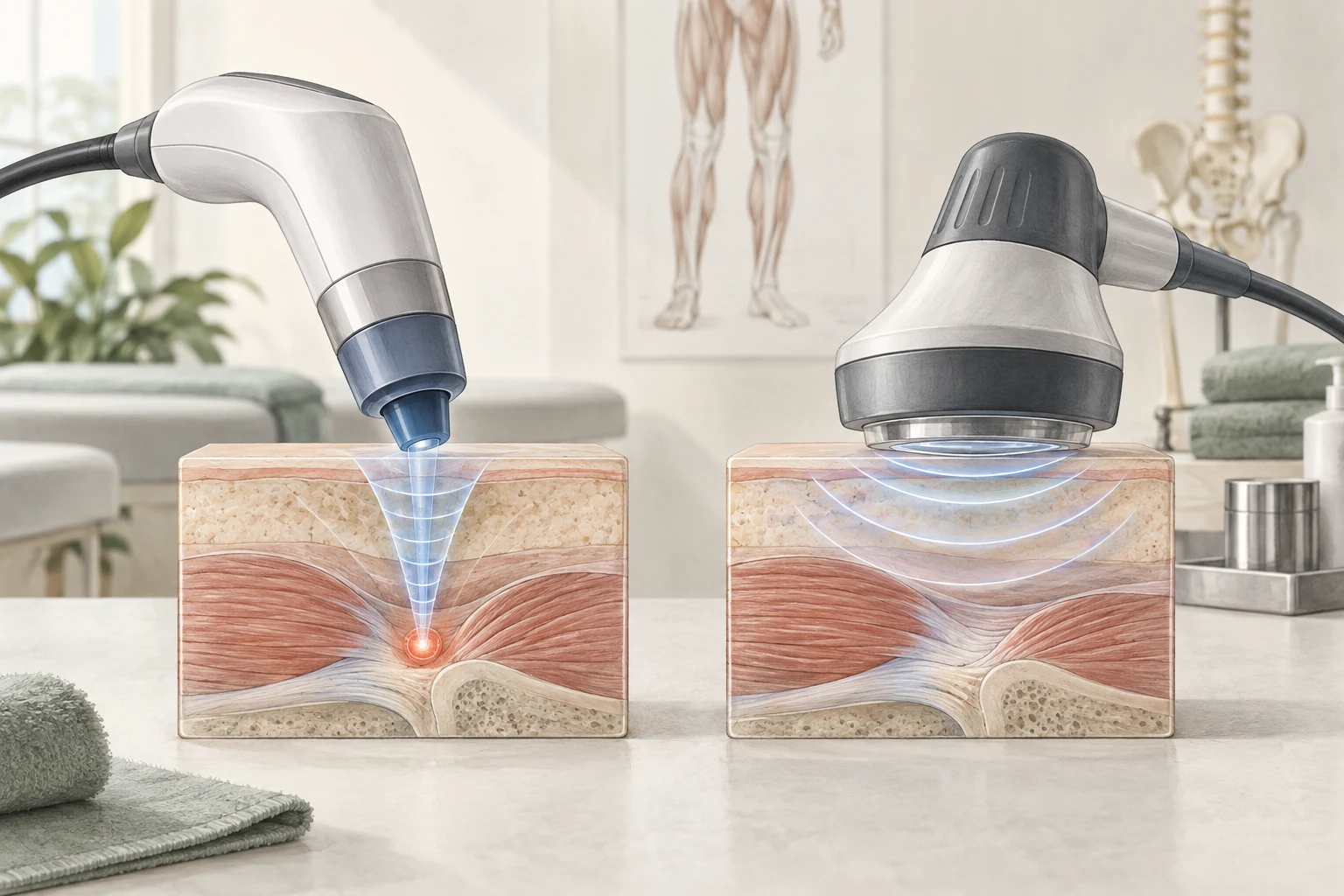
Read first what question has actually been investigated
A study may ask whether shockwave works better than placebo, better than exercises or adding anything to existing care. Those are different questions. For example, a positive result compared to no treatment does not prove that the technique is better than a good practice program.
The participants also determine the meaning. symptoms that are short-lived can be investigated differently than symptoms that have been going on for months. A study in a specific tendon is not a general test for all musculoskeletal pain.
When you read a claim, try to rewrite it in one sentence: which people did what treatment better than what comparison? If that sentence does not become clear, there is probably no information to use the claim.
An average is not a personal success rate
Investigations often report average change in pain or functioning. An average does not tell how many participants fully recovered. Also, a statistical difference does not automatically say that the difference was noticeable for each patient.
Note the measure on which success is based. Less pain, more strength, a better questionnaire score and a smaller calcium deposition are different outcomes. For your choice it is especially relevant which of them fits the purpose for which you are looking for treatment.
A practical percentage also requires explanation. Who's counted, when's measured and what happened to people who quit? Without that data, an attractive figure can't say much about what you can reasonably expect.
- For what symptom?
Check the diagnosis and participants. A single tendon finding is not self-evident for other symptoms.
- What comparison?
Find out what technique has been used and what it has been compared with: placebo, exercises or other care.
- What changed when?
Distinctive pain, functioning, and scan findings. An average improvement is not a personal success rate.
- How sure is the conclusion?
View quality, repetition and guidelines. A positive study may be associated with conservative treatment advice.
Why Dutch heel advice differs
The Specialist guideline for fasciopathy plantar from February 2026 allow ESWT to consider as a supplement under conditions. Thuisarts, based on the GPs guideline and updated in April 2026, does not recommend shockwave with long heel spur.
That difference must remain visible when a center communicates about evidence. It is only the favourable opinion that makes the assessment incomplete. You can ask the clinician how it weighs the difference in your situation.
Several recommendations may be linked to the selection and assessment of research and to the significance given to uncertainty or disadvantages. The safe conclusion is therefore not that one website itself is wrong, but that the choice needs explicit explanation.
Shoulder symptoms require an extra distinction
Alkalized and non-calcified rotator cuff symptoms are not interchangeable. The JOSPT guideline from 2025 ESWT is not recommended without calcification and leaves it open when calcification occurs. NICE advises on calcified shoulder pliers application only within study.
Shockwave is therefore too widely formulated for shoulder pain. A good explanation first mentions the diagnosis and then the uncertainty and guideline context. The country and scope of a guideline are relevant.
A study of adding another technique to shockwave also answers a different question than research into shockwave alone. A favourable combination result does not automatically reverse a reluctant advice on the basic treatment.
Recognize what makes a study stronger or weaker
Loting over treatment groups helps to make groups similar. A credible placebo can help keep expectations more level. Enough participants and an appropriate follow-up make it easier to assess the outcome.
No characteristic is enough in itself. A small randomised study can give an interesting signal without forming a solid standard of care. Interests and the role of a manufacturer are also part of the interpretation, without sponsoring automatically nullifying all results.
In addition, look at repetition. If several independent studies in similar patients come to the same conclusion, a claim is better substantiated. A loose publication deserves less definite language, especially when the outcome is greatly extended to other diseases.
Use a short check for each claim
Put a claim along six questions:
- Is it about my diagnosis?
- Has the same technique been investigated?
- What was compared to?
- What outcome improved and when?
- How sure is that result?
- Does the conclusion fit in with current guidelines?
You do not have to answer these questions independently with statistics. Take them to your clinician or ask for an explanation in plain language. The purpose is that the evidence supports the decision.
Scientific care also means that information can change. A fair treatment proposal clarifies the basis of the current opinion and the uncertainty that remains. That helps you choose without an investigation being used as a guarantee.
Frequently asked questions
Is a randomized study always convincing?
Loting is an important feature, but not the only one. Size, execution, failure, comparison and measurement period also count. A small study can be a useful start, while more independent research remains necessary before a broad claim is justified.
Why can't treatment be recommended despite a positive study?
A guideline weighs the total evidence, reliability, clinical significance and disadvantages. One positive result may be limited or not properly repeated. The study can also be about other patients or a comparison other than the final advice.
Does insecure evidence mean no one has any improvement?
No. It means we're less sure how much improvement the treatment will bring and who for. People can be improved by multiple factors. Uncertainty requires a careful conversation about expectations and a clear evaluation moment, no promise or absolute denial.
Do I have to read all the sources myself?
You do not have to. Ask for a clear explanation of the main question, findings and limitations. Original sources allow you to check the information, but the clinician proposing treatment also has a responsibility to interpret the research carefully.
Sources and evidence
- guideline Fasciopathy plantar – shockwave therapy (2026) ↗
Place of ESWT after education and practice therapy; effects, evaluation and adverse reactions in fasciopathy plantar.
- Thuisarts – long-term heel track and treatment selection (2026) ↗
Patient advice in sustained heel pain; negative advice on shockwave differs from the specialist guidance.
- Desmeules et al. – Rotator-cufftendinopathy guidance (2025) ↗
Diagnostics and active treatment of rotator-cuff symptoms; ESWT not recommended without calcification and possible option for calcification.
- NICE – ESWT study recommendation for calcified shoulder paws (2022) ↗
Efficacy uncertainty and recommendation for use in studies in the UK context.
A personal follow-up step
From insight
to an appropriate plan.
At a paid intake, we'll discuss your symptom and do targeted research. ultrasound is included at no extra cost when it makes sense. Any treatments are agreed separately.
View the initial consultation