Start with the type of claim
Not every ruling on EMTT asks for the same evidence. The fact that a device generates an electromagnetic field is a technical feature. The fact that people experience less pain is a clinical outcome. That damaged tissue completely recovers is another claim.
These levels are sometimes used interchangeably in advertising. A plausible biological mechanism may be interesting, but does not automatically predict the effect in patients. For a treatment choice you especially want to know what people with a similar symptom could achieve.
Ask therefore what outcome is meant by words such as recovery, regeneration or success. If the answer is only about a supposed cell process, it has not yet been explained how much clinical added value has been demonstrated.
What does placebo-controlled study add?
A placebo group helps to compare the effect of an active application with as similar treatment experience as possible. With this you try to keep other influences, such as attention and expectations, better apart.
The study of Dutchman and colleagues EMTT compared with placebo in 126 subjects with different musculoskeletal diagnoses. There were favorable group outcomes for pain and physical function up to 12 weeks. That's a relevant research signal.
The mixed group does require caution. A positive overall result is not automatically a separate confirmation for each diagnosis in the group. Nor can we deduce how the effect develops in the long term or how EMTT relates to any other treatment.
Combination study asks another question
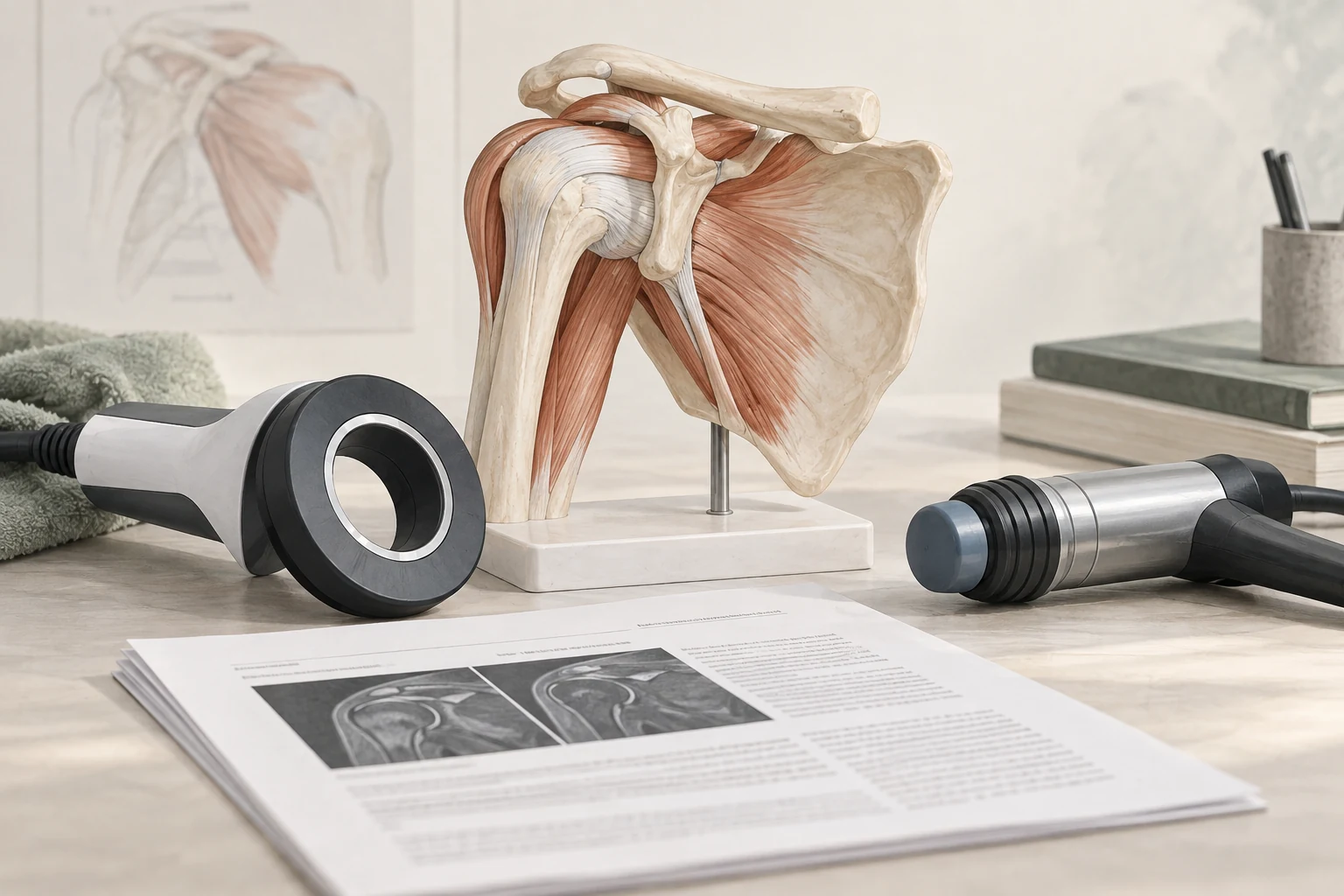
The research by Klüter from 2018 Investigated addition of EMTT to focused shockwave in long-term non-calcified rotator cufftendinopathy. Both groups also received physiotherapy. Thus, the comparison was not about EMTT as a loose replacement of active treatment.
Such design may provide guidance on the addition within that programme. It does not prove that EMTT is always needed in addition to shockwave or that radial treatment has the same combination outcome. Other research questions should be examined.
There is also a need for caution in the word synergy. Without sufficient comparison of the individual components, one cannot establish that the techniques are biologically reinforcing each other. A favourable combination result and a proven mechanism are different conclusions.
Place separate studies next to guidelines
A guideline weighs more than one result. The JOSPT guideline from 2025 recommends against shockwave for non-calcific rotator cuff tendinopathy. This remains relevant when discussing combined treatment based on the Klüter study.
A new or positive study may give rise to further study, but does not automatically change all the recommendations. The treatment proposal should explain why an application is being considered and what uncertainty remains.
For you, it is useful to ask whether the proposed care is generally recommended, an additional possibility with limited data or an application with little clinical evidence. This distinction helps to balance expectations and costs better.
Four boundaries that remain visible in a good explanation
| Border | Why it's important |
|---|---|
| Diagnosis | A result in one condition does not automatically apply to another. |
| Comparison | Placebo, active care and a combination answer other questions. |
| Time | A short-term improvement does not prove any lasting effect. |
| Outcome | Less pain does not automatically prove structural tissue repair. |
In addition, observe independent repetition and the role of interested parties. A manufacturer can provide useful technical information, but also has an interest in using the device. This means that promotional explanations do not have the same probative force as carefully conducted clinical trials.
A limited publication doesn't have to be worthless. The appropriate conclusion is often smaller than the advertising claim: there is an interesting signal that needs to be investigated further.
How do you translate uncertainty into a decision?
Uncertainty is not just for researchers. It affects how much time and money you want to spend on an additional treatment and what result you reasonably expect. Therefore, discuss possible benefits and the scenario in which little changes.
Choose a recognizable activity to follow in advance. Ask when the supplement is evaluated and when it does not make enough sense to continue. A limited consideration is better to assess than an open range without clear targets.
Your personal experience remains valuable, but doesn't prove anything to anyone. When you improve, that may be recognized without making a universal claim. If you don't improve, the plan should be able to change without being blamed for failing.
Frequently asked questions
Are there currently randomised studies to EMTT?
Yes. These studies included a comparison with placebo and a study of addition to focused shockwave. Their questions and participants differ. Therefore, the existence of a randomised study does not mean that each EMTT application has been proven.
Is research on PEMF the same as research on EMTT?
Not automatically. Pulsed electromagnetic fields include a variety of devices and applications. Make sure that technique, institutions and research questions match sufficiently. A broad collective name is not a reason to apply all the results found to a specific treatment.
Can treatment help without the mechanism being fully known?
Yes, clinical effects can be investigated while the precise mechanism is still uncertain. But the other way around, a plausible mechanism doesn't prove any clinical benefit. For the patient, the question remains what the treatment can be shown to add to pain, functioning and quality of life.
Why is no guarantee given?
Research describes groups and has limits. The personal outcome is also related to diagnosis, situation and the overall plan. A guarantee would suggest more certainty than is available. Clear objectives and evaluation provide a fairer basis for a decision.
Sources and evidence
- Hollander et al. – EMTT versus placebo in musculoskeletal symptoms (2026) ↗
Study in 126 participants, without shockwave combination, with outcomes up to 12 weeks.
- Klüter et al. — ESWT plus EMTT for non-calcific rotator cuff tendinopathy (2018) ↗
Randomised study to add EMTT to focused ESWT in 86 adults; specific population and follow-up up to 24 weeks.
- Desmeules et al. – Rotator-cufftendinopathy guidance (2025) ↗
Diagnostics and active treatment of rotator-cuff symptoms; ESWT not recommended without calcification and possible option for calcification.
A personal follow-up step
From insight
to an appropriate plan.
At a paid intake, we'll discuss your symptom and do targeted research. ultrasound is included at no extra cost when it makes sense. Any treatments are agreed separately.
View the initial consultation