What patients were involved?
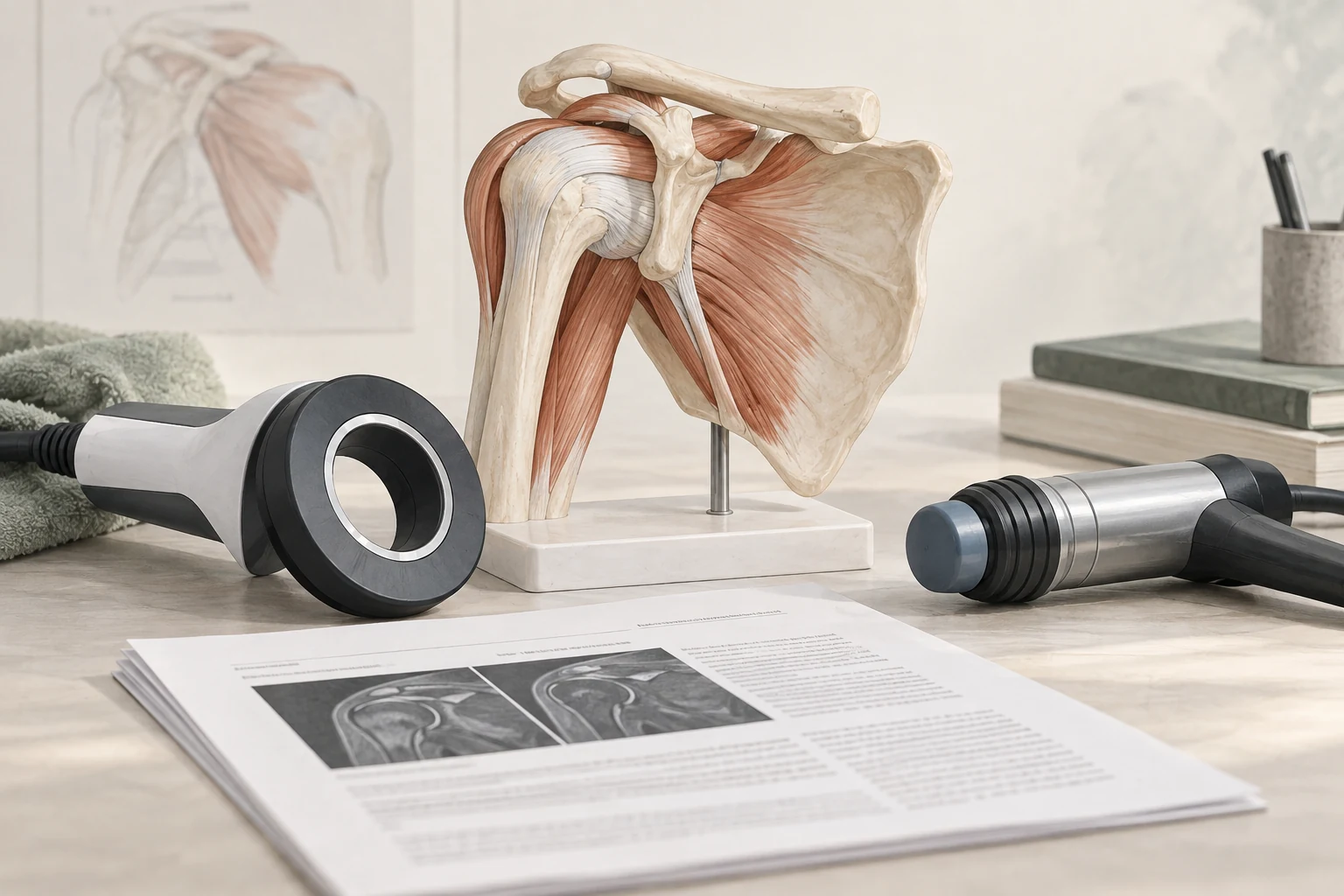
The research by Klüter and colleagues from 2018 is regularly used to support EMTT in addition to shockwave. Participants had rotator-cufftendinopathy for more than three months without calcification. That's a specific shoulder diagnosis, not a collection group with every kind of shoulder pain.
That distinction determines who the outcome can be relevant to. A frozen shoulder, an important tear in a tendon or calcification raises other questions. So you can't just say that you fit in with this research group on the basis of shoulder symptoms.
A treatment proposal must first be made clear which diagnosis fits your story and research. Then you can discuss whether the study has enough agreement to take into consideration.
What was compared to each other?
Both groups got focused shockwave. One group also received active EMTT, the other received a placebo version of EMTT. Both groups also received physiotherapy. The complete publication describes this combination setup.
The study therefore asks in particular whether the addition of EMTT made a difference within this programme. It does not simply compare EMTT with no treatment. Nor is it investigating radial shockwave as the basis of the combination.
A scheme makes the comparison understandable:
| Component | Active group | Comparison Group |
|---|---|---|
| Focused shockwave | Yes | Yes |
| Physical therapy | Yes | Yes |
| EMTT | Active | Placebo |
The common parts are important. They prevent the entire progress of the active group from being attributed to one additional technique.
What can you derive from the outcome?
The combination group had on average more favourable pain and shoulder function during the last assessment. Follow-up was up to 24 weeks. This supports a cautious positive conclusion on the addition to this specific research situation.
It's not a personal success rate. An average score does not tell how many people became completely pain-free or what outcome you will have. There is also no evidence from this comparison for a lasting effect over several years.
For a patient, it is particularly relevant whether the measured outcome is appropriate for one's own purpose. A favourable pain or function score may have meaning, but is not equal to returning to any job or sports load. That step requires an own assessment.
Why the context of the guideline is included
The JOSPT guideline for rotator cufftendinopathy from 2025 recommends against ESWT for symptoms without calcification. This is an important qualification, because the positive combination study concerned non-calcific shoulder tendon symptoms.
A separate study of an addition does not automatically reverse a guideline opinion on basic treatment. So you have to keep two questions apart: did the addition in the study show an advantage, and is the total treatment program a natural first choice? The first can be positive while the second can remain cautious.
A careful center mentions both. Otherwise, there is the impression that a limited research result is sufficient to offer a combination as an established standard.
What has not yet been conclusively demonstrated?
The study included a limited group and did not have a separate arm with EMTT alone. This means that you cannot determine whether both techniques are biologically reinforcing each other. The word synergy requires more than a better result from one combination compared to another.
Generalisation to other conditions is also not justified. heel pain, Achilles tendon symptoms and tennis elbow have not been studied in this study. The same applies to a package in which other techniques are added.
In addition, independent repetition and carefully reported larger studies are desirable. Interests, intent and limitations are part of the interpretation. A promising outcome deserves follow-up research, no extension to claims that fall outside the research question.
How do you use this in a treatment interview?
First, ask if your diagnosis matches the surveyed group. Then discuss why a combination is proposed despite the cautious guideline context. A substantive answer should make the uncertainty visible.
Also ask which active plan you keep following and how the added value is evaluated. When several parts change at the same time, it is personally difficult to determine which part makes a difference. That's no reason not to do anything, but to keep the overall plan clear.
A justifiable expectation is that there is a positive but limited research signal for this specific supplement. The choice requires consideration of possible profits, uncertainty, security, time and costs. This gives the study a suitable place in the conversation.
Frequently asked questions
Does the investigation prove that EMTT always works better with shockwave?
No. It investigated one specific combination in non-calcified rotator cufftendinopathy. The outcome does not automatically apply to other tendons, other techniques or other treatment programs. A general claim that combining is always superior goes beyond the data.
Is this research about shoulder calcification?
No. The symptoms of the tendons in the shoulder were not calcified. That distinction is essential. In case of calcified symptoms you should look at research and guidelines that actually treat that diagnosis; the title shoulder examination alone is insufficient for that.
Why isn't an exact success rate mentioned?
The study reports group outcomes for pain and function. You can't just translate it into the chance that an individual patient will fully recover. In addition, limitations in size and reporting exist. A qualitative, defined explanation prevents false security.
Is this combination the best choice by default?
No. Current guidance advice, diagnosis and your previous treatment should be considered. The positive study of the addition does not constitute a general recommendation for the overall programme. Discuss why the combination in your situation is being considered and what alternatives exist.
Sources and evidence
- Klüter et al. — ESWT plus EMTT for non-calcific rotator cuff tendinopathy (2018) ↗
Randomised study to add EMTT to focused ESWT in 86 adults; specific population and follow-up up to 24 weeks.
- Klüter et al. – full study publication (2018) ↗
Design, additional physiotherapy, results and limitations of the shoulder examination.
- Desmeules et al. – Rotator-cufftendinopathy guidance (2025) ↗
Diagnostics and active treatment of rotator-cuff symptoms; ESWT not recommended without calcification and possible option for calcification.
A personal follow-up step
From insight
to an appropriate plan.
At a paid intake, we'll discuss your symptom and do targeted research. ultrasound is included at no extra cost when it makes sense. Any treatments are agreed separately.
View the initial consultation