What happens during shockwave?
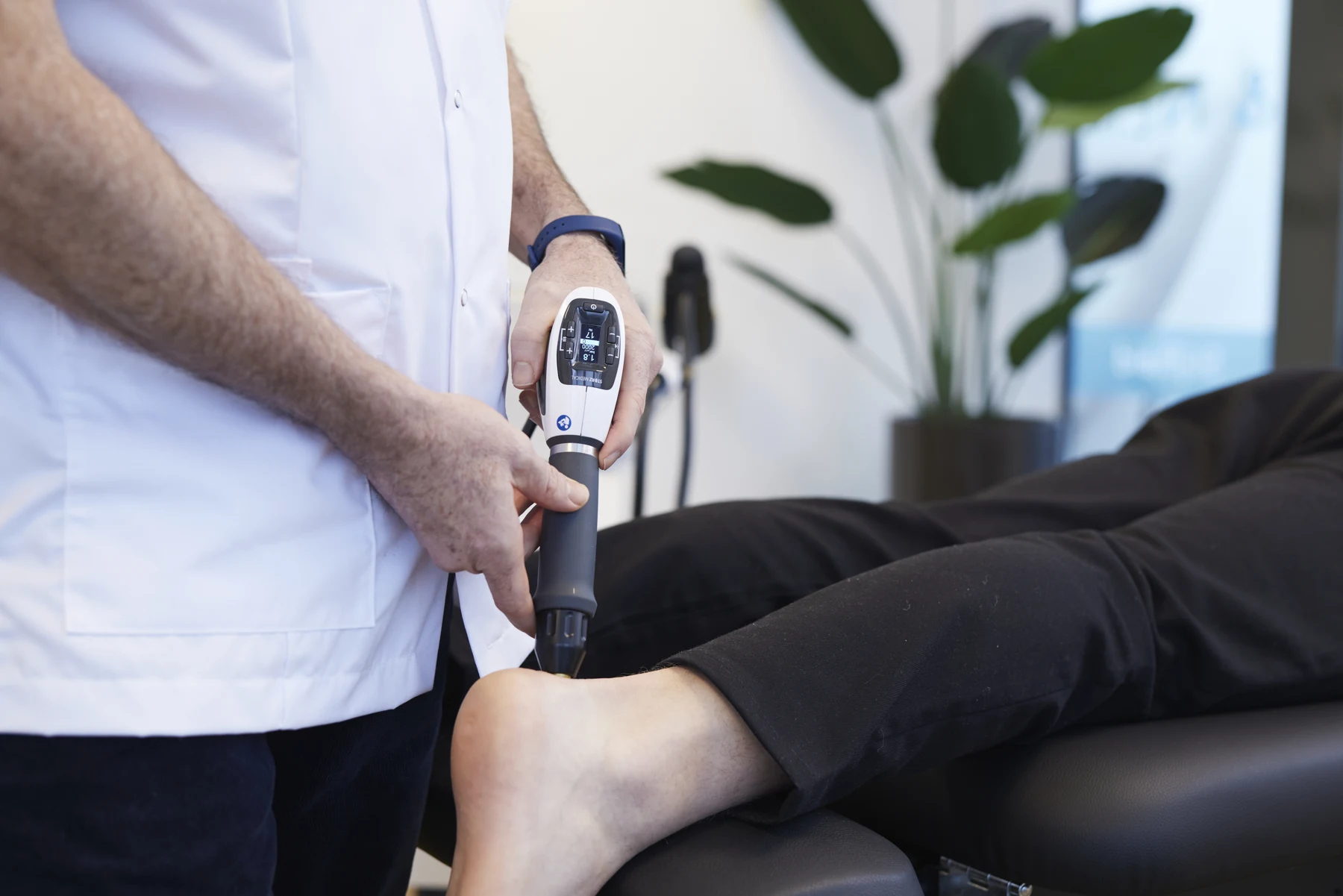
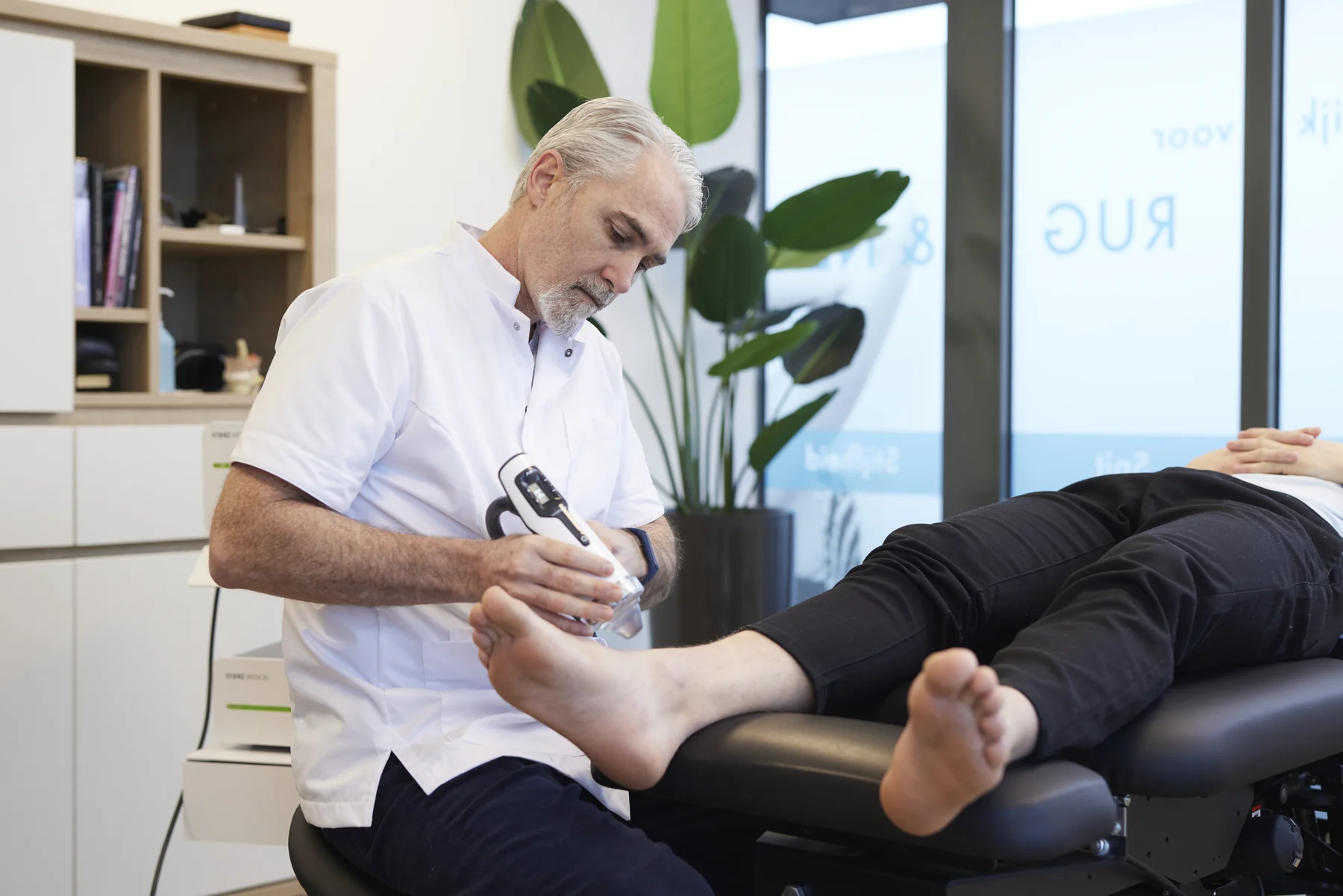
During a shockwave treatment, the clinician holds an applicator against the skin. A contact device helps transfer the pulses. You usually feel repeated ticking or an incentive in the treated area. The setting and position are aligned to the target area, the device and your response. A painful treatment is not proof that it works better.
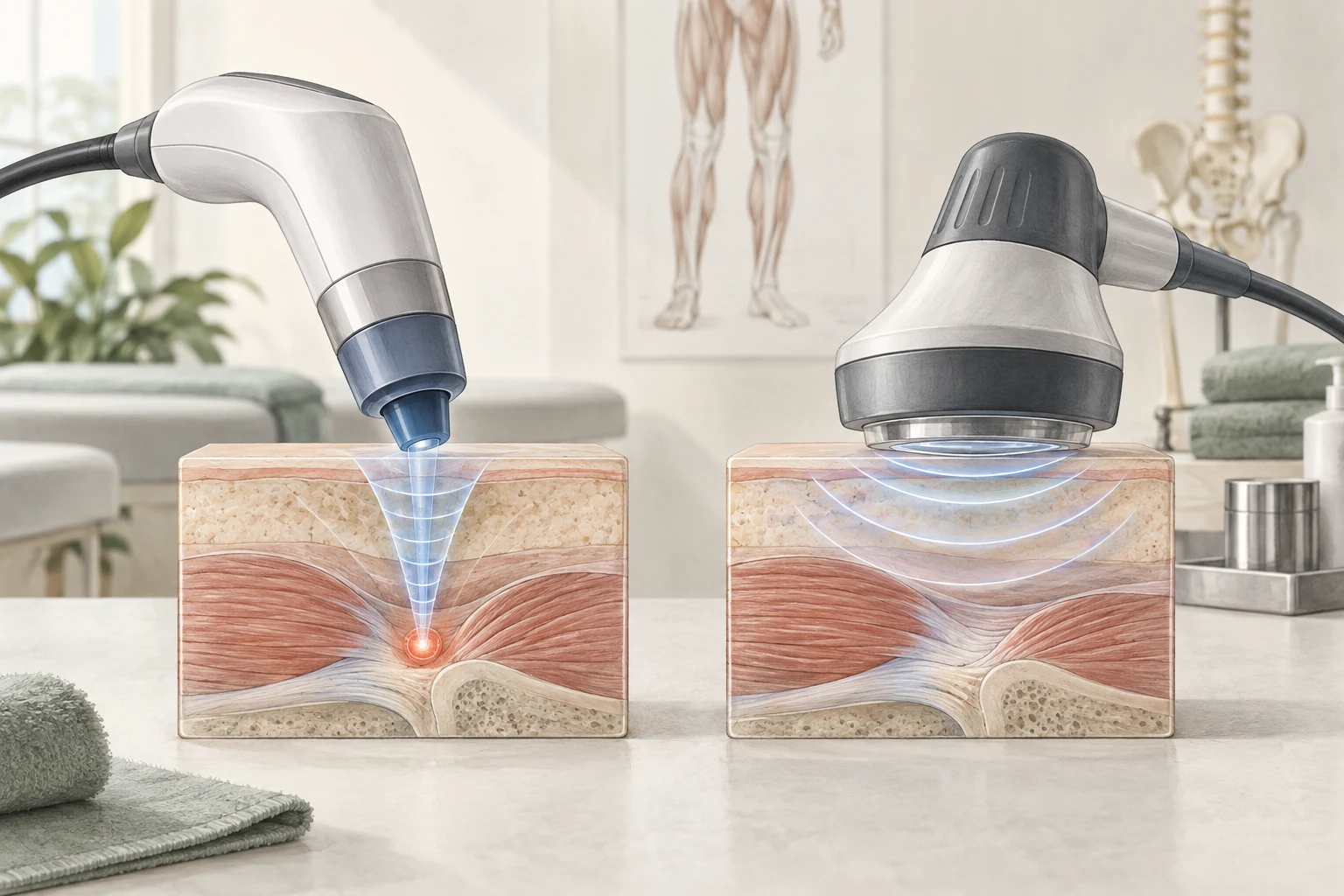
The abbreviation ESWT stands for extracorporeal shockwave therapy: treatment with shock waves generated outside the body. In daily practice, the name shockwave is also used for radial pressure waves. The ISMST distinguishes these techniques because their physical characteristics differ. That distinction helps to read a treatment proposal.
A session is only one part of the decision. The question of why this tissue is being treated is a question of how many pulses are being used. Without a sufficiently clear explanation for the symptom, a technically correct session can be an illogical choice.
Two techniques, different possibilities
Focused shockwave bundles the energy into a particular area. Radial pressure waves are spreading from the point of contact. What makes sense depends, among other things, on the location of the symptom and the available investigation. Therefore, you cannot derive from the term deeper or more powerful which treatment is better for you.
Ask in a proposal what technique is meant. Research in which radial treatment has been studied in a specific tendon does not automatically prove the same for focused treatment in another tendon. Also combinations are not self-better because they contain more techniques.
A useful comparison is that between tools: tell the characteristics what you can do with them, but not yet whether the chosen action is necessary. The same applies to a treatment device. The diagnosis and the treatment target determine whether those properties become relevant.
When does it come up?
Shockwave is regularly considered in the case of longer existing symptoms that do not recover adequately with an appropriate first approach. In addition, heel, Achilles Tendon or other tendon areas can be discussed. However, the name of the pain site has not yet been diagnosed. heel pain, for example, can have several causes, which are not covered by the same advice.
For fasciopathy, plantaris advises the Dutch guideline of 2026 to consider shockwave after at least 12 weeks of adequate education and practice therapy without effect, if no shockwave has been given in this episode. That is a targeted recommendation, not a general starting rule for every tendon.
In an intake is therefore relevant what you have actually tried. I've done exercises can mean a few loose attempts, but also months of guided construction. What load, guidance and evaluation included could change the follow-up proposal.
Opinions shall not be unanimous: Thuisarts doesn't recommend shockwave with long heel spur. Discuss this difference with your clinician; an additional option is not a self-evident standard treatment.
In case of symptoms of tendons in the shoulder without calcification, the JOSPT guideline from 2025 Shockwave off. An indication per diagnosis should therefore also be substantiated.
What can you reasonably expect?
A useful treatment target is less nuisance in a recognizable activity, such as walking to the store or packing something out of a closet. That is more concrete than the promise that the tendon will be fully restored. Even if symptoms are to be reduced, it is often necessary to build up taxable capacity.
Research describes averages of groups. Some people are clearly improving, others are limited or not. A positive research result therefore offers a reason to discuss a treatment without predicting your outcome. On the other hand, uncertain evidence does not exclude that someone is experiencing improvement; it mainly limits how definitely this improvement can be attributed in advance to the technique.
Make pre-arrangements about the measurement moment. Immediately after a session, feeling less pain can be pleasant, but says little about the possibilities during work or sports a few weeks later.
Why exercises and loads continue to count
Your tendon is also burdened between the appointments. A treatment room can't take away the amount of stairs, lifting or training in your week. Therefore, a plan should describe how daily activities and targeted exercises are aligned.
For example, let's say walking is your main goal. Then you want to follow which distance is feasible, how many breaks are needed and how the reaction fails later. When you report less pain because you're running almost no longer, that's a different outcome than when you can do more with the same symptoms.
A treatment can give space to practice further, but does not automatically replace the practice. Discuss who takes care of the guidance and how information is shared when multiple traders are involved. That avoids conflicting assignments.
Five questions for a treatment proposal
Before a decision, write down the following questions:
- What diagnosis is likely, and what uncertainty remains?
- Why is shockwave a logical addition right now?
- Which technique is used and what research is appropriate?
- What are we going to do next to it to build my functioning?
- When do we decide to continue, adapt or stop?
Add your own main activity. I want to be able to stand another working day... which is the direction of the conversation. Also ask for possible afterpain, cost and accessibility in case of an unexpected response.
A careful proposal can end with another step first. This can be explanation, adapted exercise load or additional research. That choice should be justified as seriously as starting shockwave.
Frequently asked questions
Is shockwave the same as current therapy?
No. In shockwave and radial pressure waves mechanical energy is transmitted via an applicator. Some devices use electricity to generate the pulses, but that doesn't mean that it's a treatment that sends power through electrodes through your body.
Should shockwave hurt a lot?
A treatment can be sensitive. Report what you are experiencing, so that the operator can assess whether the application needs to be modified. Much pain is not a reliable measure of effectiveness and you do not have to hide symptoms to make the trajectory work.
Is a heel spur being broken?
That's not a good general explanation of shockwave in heel pain. The aim is to improve symptoms and function in an appropriate diagnosis. A visible bone protrude does not need to be the explanation for the pain and does not need to disappear to function better.
Can I book a series of treatments right away?
An ex ante assessment is wise, because the right choice depends on the symptom and previous approach. Ask first for a proposal with purpose, evaluation time and costs. This will prevent the number of appointments booked from determining the substantive decision.
Sources and evidence
- ISMST – Recommendations and definitions ↗
Technical differences, clinical selection and safety balances in shockwave.
- guideline Fasciopathy plantar – shockwave therapy (2026) ↗
Place of ESWT after education and practice therapy; effects, evaluation and adverse reactions in fasciopathy plantar.
- Thuisarts – long-term heel track and treatment selection (2026) ↗
Patient advice in sustained heel pain; negative advice on shockwave differs from the specialist guidance.
- Desmeules et al. – Rotator-cufftendinopathy guidance (2025) ↗
Diagnostics and active treatment of rotator-cuff symptoms; ESWT not recommended without calcification and possible option for calcification.
A personal follow-up step
From insight
to an appropriate plan.
At a paid intake, we'll discuss your symptom and do targeted research. ultrasound is included at no extra cost when it makes sense. Any treatments are agreed separately.
View the initial consultation