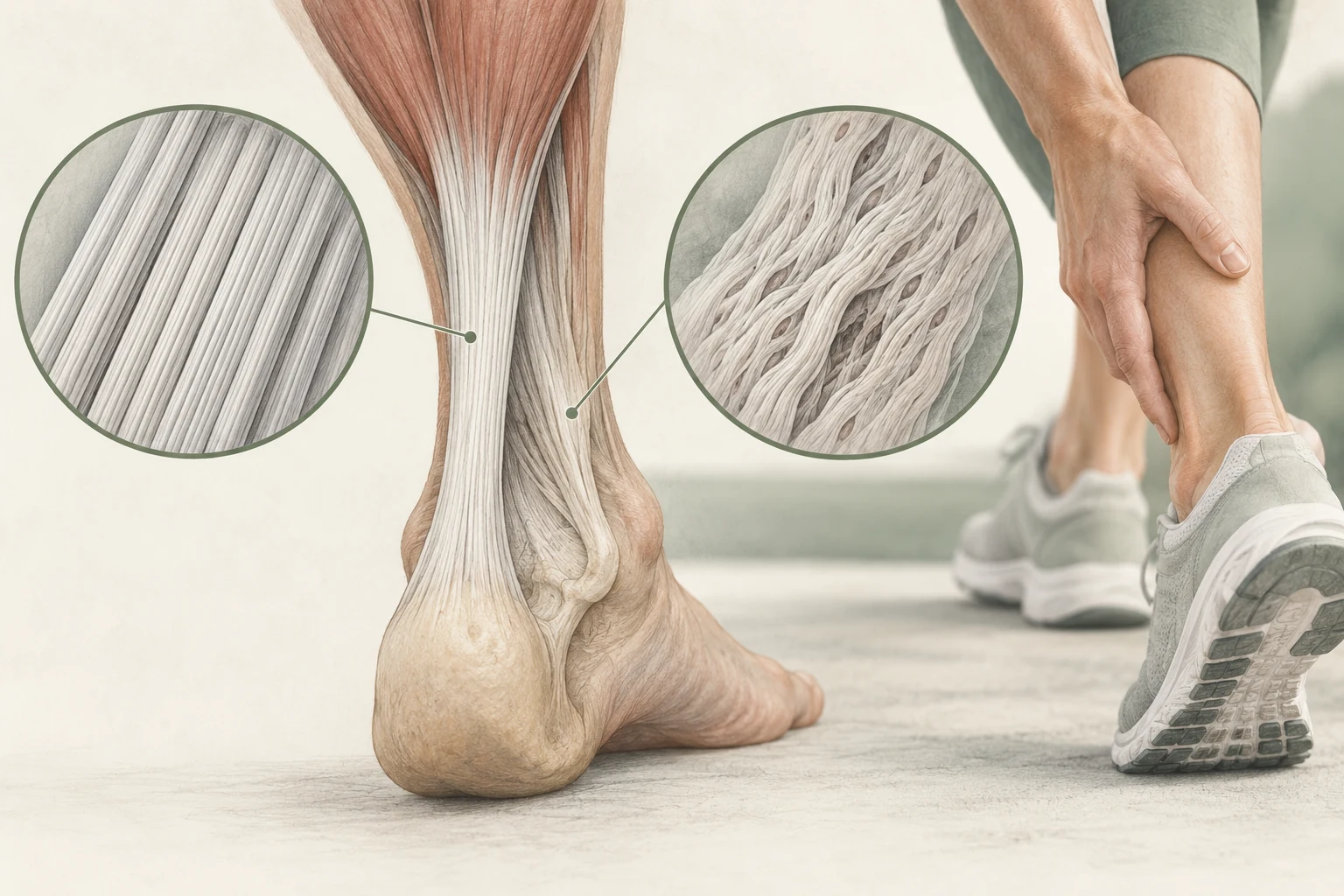
Why different words can be confusing
Your GP can talk about tendons symptoms, a report on tendinopathy and a website on tendinitis. That doesn't have to mean that everyone means another condition. Sometimes the words describe the same symptom in a different way.
However, words can guide expectations. If you have inflammation, you might be thinking of medication and rest. In the event of wear and tear, you may expect nothing to change. Such conclusions do not automatically follow from the term used.
Therefore, ask what findings are behind the name. A diagnosis is only useful when it is clear what it explains, what is still uncertain and what plan fits.
What does tendinopathy mean?
The international ICON consensus on terminology chooses tendinopathy as the term for persistent tendon pain and loss of function in relation to mechanical load. The focus is on the clinical pattern.
The term does not prescribe that one specific microscopic or biochemical process has been established. In the speaking room, you usually cannot fully assess such processes. Therefore, the word is broader than a statement that there is only inflammation or only degeneration.
For you, this means that the name mainly gives direction to assessment and guidance. The seriousness of your symptom and your possibilities should also be described separately.
What do you mean by tendinitis?
In everyday language, tendinitis is often used for a painful tendon, even when no precise statement of inflammatory activity has been made. That makes the term understandable, but sometimes less precise.
Nor is it appropriate to deduce from another term that ignition processes can never play a role. The clinical significance depends on the condition and context. Words should not replace the assessment.
So, in case of a drug or treatment proposal, ask for the reason. A name that ends with inflammation does not automatically prove that a particular medicine is needed. Do not change prescribed medication based on a terminological discussion on the internet.
Tendinosis, tearing and other image terms
Tendiosis is sometimes used to describe changes in tendon tissue. The ICON consensus points to uncertainty surrounding that term. A picture description and a clinical symptom are not automatically the same.
A tear has a different meaning: an interruption of tendon tissue is meant. The size, location, origin and functioning then determine how that finding is assessed. A tear should therefore not simply be used as another word for any tendinopathy.
If a report contains several terms, ask which main conclusion is relevant. The goal is not to remember all the professional language, but to understand what is changing for your daily activities and treatment.
The location remains important
Different areas can also be distinguished within one tendon. The Dutch Achilles guideline, for example, distinguishes between attachment symptoms and symptoms in the middle piece. That positioning can have significance for assessment and guidance.
A general term such as tendinitis easily eliminates such differences. Therefore it is useful to know exactly where the symptom is located and how it matches your symptoms.
Other conditions may also cause pain with a tendon insertion. The clinic needs to look further at an inappropriate pattern. A trusted label should not prevent relevant medical information from being considered.
Translate the diagnosis to a practical plan
Use three columns in the conversation:
| Term I hear | What I want to understand | Practical consequence |
|---|---|---|
| Tendinopathy | Which symptoms pattern fits? | What do we follow during construction? |
| Structural change | What's really seen? | Does it change my plan? |
| Inflammation | How is that term used here? | Why is this treatment proposed? |
A clear explanation makes room for recovery without promising that any image change will disappear. It links the name to functioning and an appropriate approach.
If new symptoms arise or the course does not fit, the work diagnosis may be revised. This does not have to be a mistake; new information can improve the assessment. The value of a term is ultimately in the care it helps to guide, not in how technical or final it sounds.
Frequently asked questions
Is tendinopathy the same as wear and tear?
No. Tendinopathy describes a clinical pattern of persistent tendon pain and loss of function upon load. The word does not say that a tendon is simply worn out or cannot improve. Ask what concrete findings and possibilities are relevant in your situation.
Does tendinopathy mean there's no inflammation?
You can't derive that from the term alone. The term is not intended to capture one specific tissue process. The clinical assessment and any additional findings shall determine which explanations and treatments are appropriate.
Why does my clinician use a name other than the report?
A report often describes image characteristics, while the operator identifies the whole pattern of symptoms. Ask if both are related to the same findings and what conclusion the treatment plan determines. Several words do not have to mean a real difference of diagnosis.
Should the treatment change if the name changes?
Not automatically. Sometimes, only more precise language is used. Another treatment is logical when the clinical explanation or relevant information changes. Therefore, ask what is new in substance and what practical consequence is associated with it.
Sources and evidence
- Scott et al. – ICON consensus on tendinopathy terminology (2020) ↗
Tendinopathy as a clinical term for persistent load-related pain in a tendon and loss of function; no automatic pronunciation of tissue process.
- guideline Achilles tendinopathy – diagnosis (2020) ↗
Clinical diagnosis, targeted imaging and limits of ultrasound information.
A personal follow-up step
From insight
to an appropriate plan.
At a paid intake, we'll discuss your symptom and do targeted research. ultrasound is included at no extra cost when it makes sense. Any treatments are agreed separately.
View the initial consultation