Two tools with another application
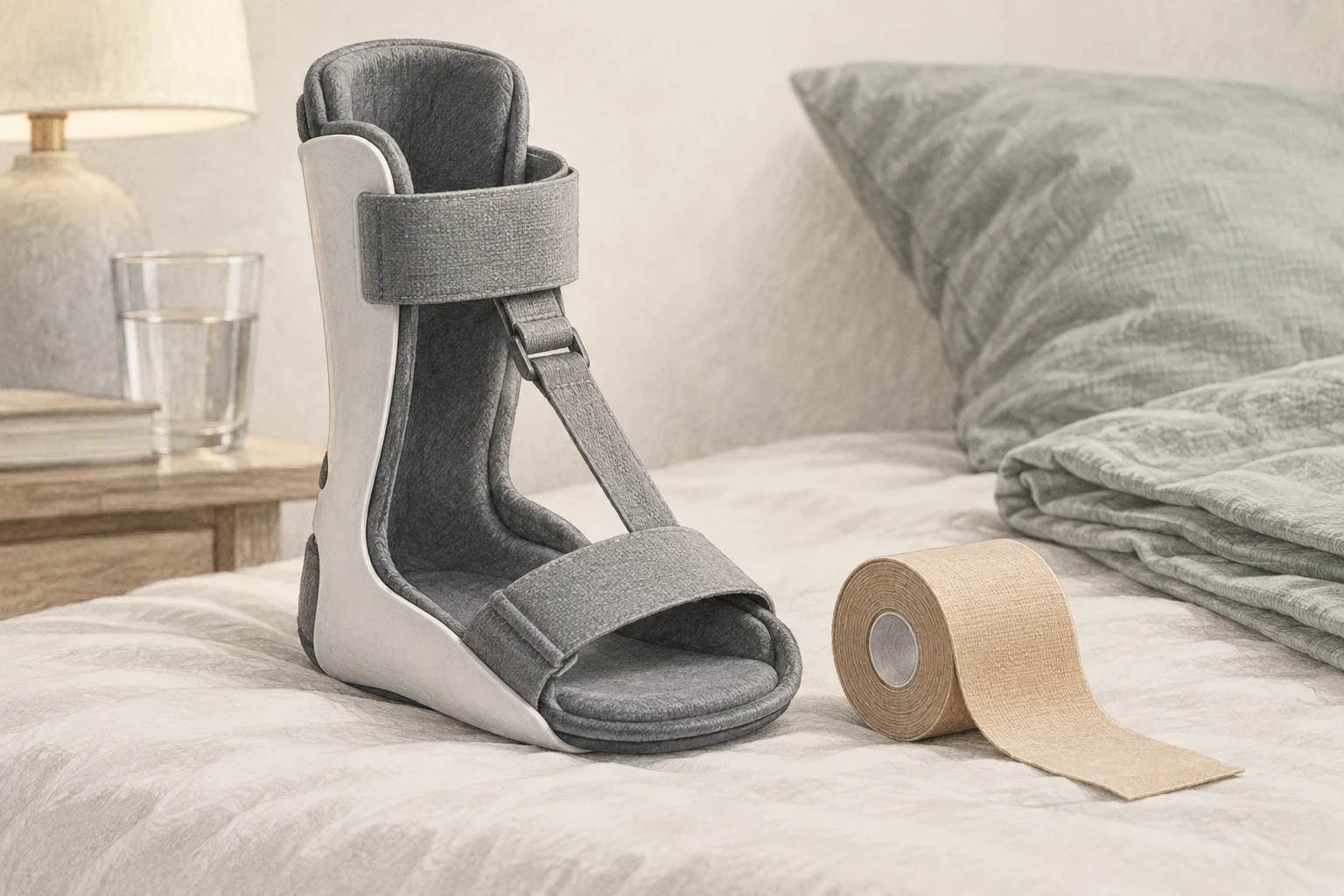
Tape is applied to the foot and can affect the way a movement feels. A night splint keeps the foot in a certain position during rest. A special sock with a ligament to the toes works differently in execution. They are not interchangeable products, even when all are sold as a tool for heel tracks.
First determine which problem you want to influence. Especially pain in the first morning steps is a different question than discomfort during a long shift. Ask what the chosen application could add to this and how you notice if that happens. The number of tools in your plan is not a measure of the quality of the treatment.
What do we know about tape?
One randomized study of Radford and colleagues after one week, found a slight improvement in starting pain with low-Dye tape compared to the comparator treatment. Other outcomes were not convincingly different. Undesirable reactions were also observed. This supports a modest, temporary expectation and no claim that tape will permanently remedy the underlying symptom.
Different tape methods and materials are used. An examination result for one application does not automatically apply to each brand or paste. Ask who applies the tape, how long it is intended to stay in place and when removal is necessary. Sticking more and more tightly because the effect decreases is not a sensible way to build up the treatment.
What do we know about a night splint?
In a small randomised Wheeler study didn't give any convincing extra improvement over the exercise program alone by adding a night splint to a home practice program. Such a result does not prove that no one can benefit, but makes restraint appropriate to great promises.
Also Thuisarts discusses uncertainty on pain reduction by a splint or special sock. Comfort and sleep are relevant outcomes next to the first steps. If a tool makes you sleep worse, it's supposed to weigh in. A tool that can theoretically add something but can't be used in practice has little value to your plan.
Pay attention to fit, skin and practical safety
Discuss skin problems in advance, reduced sensitivity and conditions that make you less aware of pressure or irritation. Tape may itch or damage the skin; a splint may give pressure points. Ask explicitly which symptoms are reason to stop the tool and contact us. Increasing sensational change or discoloration should not be ignored as common habit.
Think about getting up in the dark with a night splint. Is the product intended to walk or should it be finished first? Follow the instructions for use and keep the route safe. For tape, hygiene, moisture and your daily tasks count. A care advice should be appropriate to the material that has actually been used.
Pre-compare the charges and the possible profits
| Question | Tape | Night splint or special sock |
|---|---|---|
| When do you use it? | Usually during daily activities | During rest or sleep according to instruction |
| What are you following? | Comfort, walking, skin reaction and the agreed goal | Starting pain, wearing comfort, pressure spots and sleep |
| What does it take to be practical? | Application, care and replacement | Fit, attract and safe use when standing up |
| What's to be clear? | Delete moment and check appointment | Habitation, duration of use and reasons for discontinuation |
The table describes points of interest; it does not choose treatment for you. One example is someone who wants to follow the starting pain. If a splint, new shoes and a heavier exercise program are started simultaneously, it becomes difficult to assess the added value of the splint. A clearer trial helps with the follow-up decision.
Arrange when the experiment is finished
A tool deserves an evaluation, even if it is easy to buy again. Capture what change you hope to notice and how you keep track of it. Also discuss whether it interferes with other activities or sleep. A small benefit in pain can be valuable to one person and outweigh the practical burden for the other.
In case of insufficient effect, the logical step is not automatically tightened or worn longer. Check the application and see if continuing is useful. The basis of the approach remains an understandable assessment and approximation of physical load. A tool can get a place in it, but does not need to become a permanent condition to dare use your foot.
Frequently asked questions
Does tape only work when it's very tight?
No. Tighter is not proof of better operation and can give pressure, skin problems or sensational change. Let me explain how the chosen technique should be and when to remove the tape. Do not adjust the tension on your own.
Should I endure a night splint when it makes me sleep badly?
Sleep disturbance should be included in the consideration. Discuss fit, application and the utility of continuing when the tool clearly interferes with your night's sleep. The goal is a useful improvement, not to persevere as long as possible with an unpleasant product.
Can I use tape and a night splint at once?
Sometimes parts are combined, but that is not automatically better. Let us assess whether both have a clear function and how you follow effect and side effects. Several new measures at the same time make it more difficult to determine what really adds.
Does less pain with tape prove I need support soles?
A temporary reaction to tape is not conclusive evidence of the effect of a sole. The applications differ. The reaction can give a discussion material about comfort and load, after which a separate consideration of soles, expectations and costs remains necessary.
Sources and evidence
- Radford et al. — Low-Dye taping for plantar heel pain (2006) ↗
Limited improvement in starting pain after one week of tape, with possible unwanted reactions.
- Wheeler — Night splint added to home rehabilitation (2017) ↗
Small randomised study without convincing additional win of night splint in addition to practice.
- Thuisarts — Choosing heel track and treatment for a long time (2026) ↗
Night splint, tape and uncertainty about treatments in long-term helping.
A personal follow-up step
From insight
to an appropriate plan.
At a paid intake, we'll discuss your symptom and do targeted research. ultrasound is included at no extra cost when it makes sense. Any treatments are agreed separately.
View the initial consultation