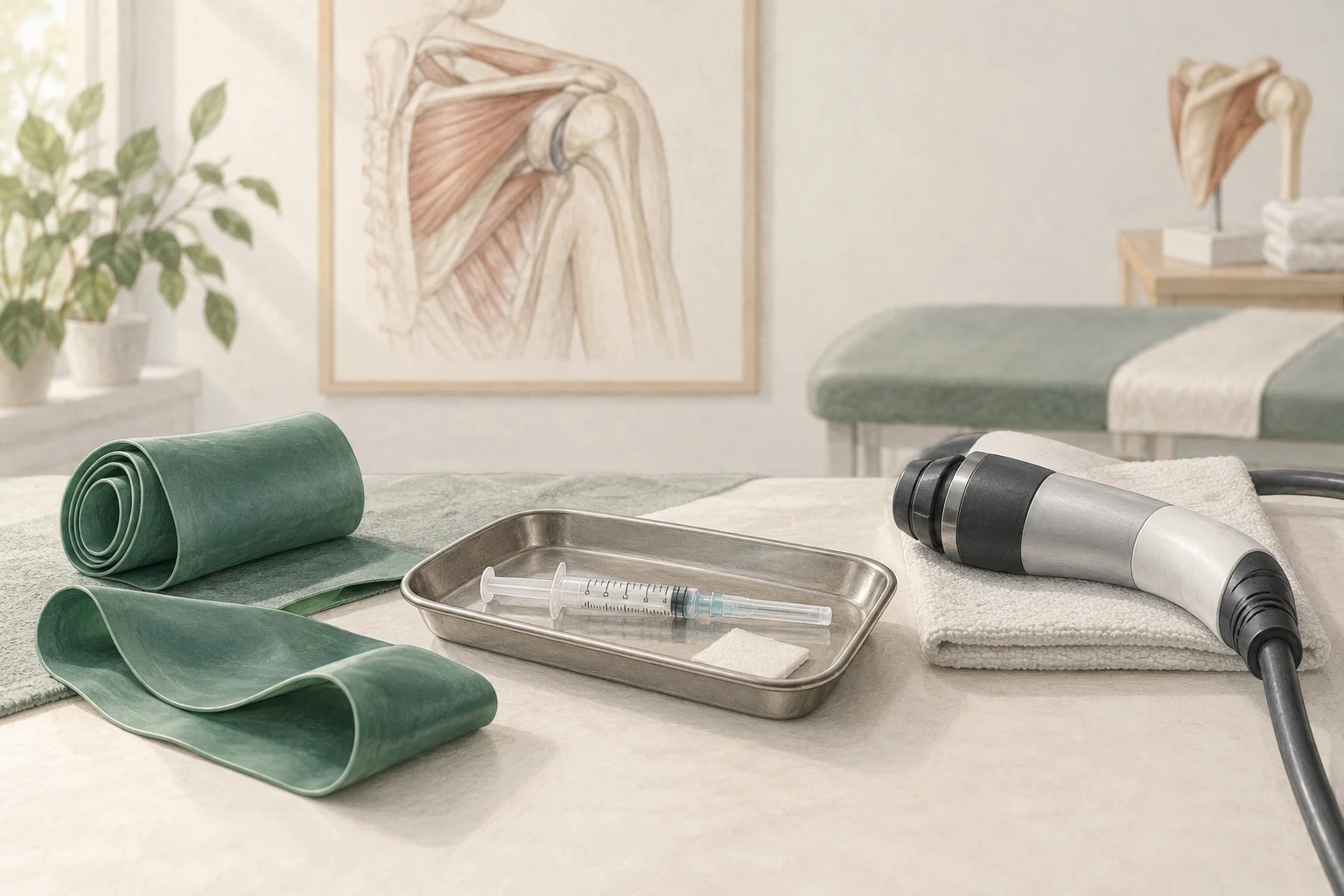
The diagnosis determines which comparison is useful
A painful shoulder is not a condition. symptoms of tendons without lime, calcification in a tendon, frozen shoulder and a complete tear in a tendon ask different considerations. Without that first step, you compare treatments that may be intended for another question.
Therefore, ask where the work diagnosis is based. What findings from the conversation and research fit in? Is imaging necessary to make the choice or is it only adding a detail? The answer helps to understand a treatment proposal.
Then write down the problem you want to tackle. If the main limitation is sleep, the explanation should be about sleep and pain. If you can't raise your arm after a fall, research into that loss of function is more important than choosing three treatment names.
Practice: learning to tax and function
The International Rotator Cuff guideline advises an active exercise program as the first treatment in rotator cufftendinopathy. The exercises and load should be tailored to the person. The goal can be strength, control or a specific daily function.
A program only works if you know what to do and how it fits in your week. Ask how much guidance is needed, what you can perform independently and when a response is reason to adjust.
In the GRASP study did not give a more extensive exercise programme to the surveyed group a better outcome over 12 months than good one-off advice. This supports a targeted choice of guidance: the content and feasibility deserve more attention than automatically as many agreements as possible.
Injection: possible pain reduction with limits
A corticosteroid injection can be discussed when pain is an important obstacle. The treatment is aimed at reducing symptoms and is not evidence that a tendon has been structurally recovered. GRASP did not find any long-term benefit from an injection in the investigated rotator cuff symptoms.
According to Thuisarts on injections possible side effects and personal circumstances are included in the decision. Your medical history, other medicines and diabetes, for example, are relevant information for the doctor.
Ask what the intended goal is and what follow-up plan is included. If the pain decreases temporarily, it does not necessarily mean that you have to resume all the heavy loads immediately. Decide which activities are appropriate and when the impact is assessed. Also do not decide in advance that a short effect should always be answered with a new injection.
Shockwave: the distinction between lime and no lime
In non-calcified rotator-cufftendinopathy, the international guideline advises not to use shockwave. In calcified tendinopathy, the same guideline allows it as a possibility. That distinction should be included in every proposal.
In addition, advises: NICE shockwave in shoulder calcification solely due to insufficient evidence of efficacy. The recommendations therefore differ. A treatment interview should indicate that uncertainty.
Ask what outcome is sought, what technique would be used and what the expected extra value is above the existing plan. We treat the painful place gives insufficient information. Also long-term symptoms are not in themselves proof that a particular device treatment should now help.
Compare on the same questions
Use a simple equation to organize your conversation. The table doesn't choose treatment for you.
| Component | Ask for each option |
|---|---|
| Purpose | What kind of limitation do we intend to significantly improve? |
| Fitness | Has this option been examined in my diagnosis? |
| Effort | What do I have to do and how many appointments does it ask? |
| Disadvantages | What are the risks, inconveniences and costs relevant? |
| Alternative | What happens if I don't choose this now? |
| Evaluation | When has enough improvement been achieved or will we stop? |
For example, you want to store messages again without help. A proposal becomes concrete when it is explained how it would support that task. A smaller calcium deposition or a lower pain score during one test is not automatically the same as achieving that goal.
Take time to reflect when important answers are missing. You don't have to choose because one treatment is available the same day.
Combining also requires a reason
Sometimes a plan consists of more parts, but more treatments at the same time do not automatically mean more effect. Ask what each part adds and who guards the whole thing. Otherwise, the appointments of the doctor, physiotherapist and other caregivers can run along each other.
Tell everyone what treatments you get and what load have already been agreed. Let's record who you're addressing in the event of obvious deterioration and when jointly evaluated. This prevents each follow-up consultation from leading only to the expansion of its own part.
An appropriate outcome may also be that you first make the existing plan more feasible. New medical symptoms or a modified pattern of movement require re-evaluation. A comparison of treatments remains meaningful as long as the diagnosis and the demand for help still fit the reality.
Frequently asked questions
What is the best treatment for shoulder pain?
That question has no general answer without diagnosis. calcification in a tendon, uncalcified symptoms of tendons, stiffness and a tear require different choices. Compare treatments for your concrete purpose and the relevant justification. An available device or a previous good experience of someone else doesn't determine that.
Is an injection a replacement for exercises?
Not on its own. An injection can be discussed for reduction of symptoms, while exercises and activity arrangements have their own purpose. Ask how the components are connected. Temporarily less pain is not an automatic permission to resume all load at once.
Why is shockwave sometimes offered and sometimes not offered?
An important distinction is whether there is calcification in the rotator cuff tendon. The 2025 guideline recommends against shockwave for non-calcific tendinopathy, while allowing it as an option for calcific tendinopathy. NICE is more cautious about its use for calcific tendinopathy. Your clinician should explain the reasoning and uncertainties.
Do I have to try all the options first?
No. A logical order follows from your diagnosis, preferences, previous care and possible benefits and disadvantages. You don't have to finish a treatment list. Ask what information adds a next step and when you would decide to change the approach.
Sources and evidence
- Rotator Cuff Tendinopathy: Clinical Practice Guideline (2025) ↗
Active practice, short-term roll injections and differentiate shockwave with and without calcification.
- GRASP: exercise advice, exercise program and injection for rotator cuff symptoms (2021) ↗
No long-term benefit corticosteroid injection; exercise program versus advice.
- Thuisarts: I get a shot in a tendon or joint (2023) ↗
Patient information injection, side effects and personal medical consideration.
- NICE: shockwave when calcification of a tendon in the shoulder (2022) ↗
Research consulting on shockwave for shoulder calcification.
A personal follow-up step
From insight
to an appropriate plan.
At a paid intake, we'll discuss your symptom and do targeted research. ultrasound is included at no extra cost when it makes sense. Any treatments are agreed separately.
View the initial consultation