Why strength training isn't a match yet
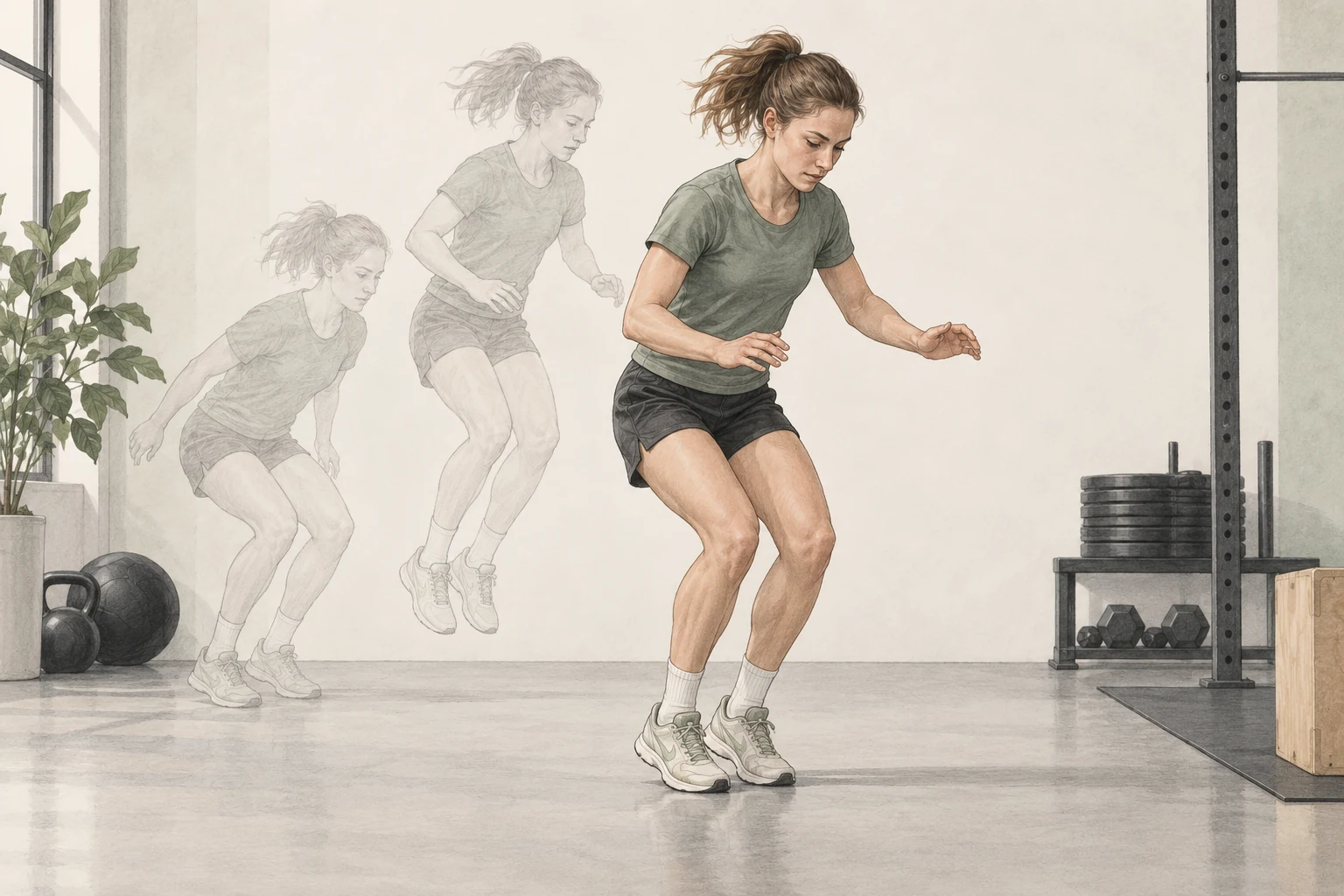
A controlled knee bending and an unexpected landing require several things. When you jump, you have to deliver power quickly and then catch the landing. In a competition there are changes in direction, fatigue and decisions under pressure of time. The fact that someone in the rehearsal room has become stronger does not automatically mean that a full match fits well again.
The Dutch guideline on patella symptoms of tendons describes a build-up of education and strength to explosive, sport-specific loads. The precise exercises depend on the sport and the person. A basketball player, dancer and recreational volleyball player have different goals for motion.
So start the conversation at what you have to be able to do eventually. Is that a few turns off during a quiet training, repeated maximum jumping on the net or a long choreography full of landings? Without that end goal, a training schedule can be feasible and yet not enough preparation for the activity you come for.
Counting jumps is useful, but not enough
The number of jumps makes a training week more concrete, but two sets with the same number can feel very different. A low jump at the place differs from a maximum run, a one-legged landing or a jump where an opponent forces you to change direction.
Therefore, describe the load with multiple buttons:
| Component | Example of a change |
|---|---|
| Quantity | More repetitions or more training minutes |
| Intensity | Jump higher or turn off more powerful |
| Implementation | From predictable to reactive or sport specific |
| Rest | Less pause between actions |
| Context | From loose exercise to interplay and competition |
This is not a mandatory roadmap. It shows why more jumping is not one change. When several buttons are turned up at the same time, it becomes difficult to determine which step was too large afterwards. Therefore make changes recognizable and discussable.
Choose in advance what an appropriate response means
The goal of monitoring is to steer your training, not treat every sensation as a danger. Decide which reaction during the training is acceptable, how long it may last and what you want to be able to do the next day. Those appointments must fit your initial condition and may change during recovery.
Next to pain, look for function. Does your landing change visibly because you can't see the knee? Are you skipping unnoticed exercises? Is the stairs clearly not going well the next morning? Such changes may indicate that the total load should be reviewed, even if one pain rate does not change much.
A short log can consist of three lines: what was the new step, how did it go and how was the response to a fixed daily activity afterwards? An extensive spreadsheet is usually not necessary. The important thing is that you, trainer and clinician use the same information.
The rest of your week counts.
A practice session rarely stands on its own. A school day with lots of stairs, a side job where you squat, strength training and team training together can form a busy day. If planning only shows rehabilitation exercises, an important part of the load is missing.
A think example: you extend the jumping exercises on Tuesdays and are asked unexpectedly on Wednesdays for an extra team training. Those are two changes in a short time. The question is not only whether the exercises went well on Tuesday, but whether the combination fits the construction that was agreed.
Discuss with the trainer which parts are adjustable. Taking part in tactics, technique without much jumps or a demarcated training part can sometimes fit better than the choice between everything and nothing. It is useful if the trainer knows when to stop and does not have to judge on the spot whether you are sufficiently motivated.
Tougher training is not always the missing step
One randomised study in 44 adults compared slow strength training with heavy and moderate resistance, while maintaining the exercise volume. Both groups improved; the heavier load did not yield superior clinical results. That research does not determine your ideal weight, but undermines the simple assumption that maximum heavy is always better.
During jump construction, the challenge may lie in speed, repetition or confidence. A clinician can examine whether you need more basic power, or whether the transition to fast movements requires attention. Adding even more weight to one well-known exercise is not automatically the solution for trouble with unexpected landings.
Strength training often remains a part of the whole. The question is how it fits next to the new jump load. Expanding a full exercise week without making room can reduce the feasibility and makes it more difficult to assess progress fairly.
From training to participating and performing
Make a distinction between partial training, full training treaties and performance at competition level. Those goals do not need to be achieved simultaneously. A return decision may take into account the duration of a contest, replacement options and the importance of repeated taxation over several days.
Also record what you do in a relapse. Which training parts are temporarily adjusted and when will you contact us? A pre-arranged appointment prevents one bad day from causing panic or pressure from a team to set aside all signals. The calendar can give direction, but should not overrule the response of the knee.
Frequently asked questions
Can there be pain during jumping?
There is no universal limit for each knee. Discuss a personal appointment about pain, execution and recovery response. Also pay attention to increasing care, less can be done the next day and a pattern of deterioration over multiple trainings.
How much percent can I build a week?
A fixed percentage does not take sufficient account of jump height, landing, training duration and other activities. A small percentage increase can be heavy if the intensity increases simultaneously. Choose which variable changes together and on the basis of which the next step is taken.
Is a pain-free squat enough for a game?
No, that's one possible observation. A competition often demands repeated fast force, unpredictable actions and stress under fatigue. The assessment should be consistent with those requirements and with how you tolerate appropriate training.
What do I discuss with my trainer?
Tell us which parts you can do, which are temporarily limited and how you respond to expansion. Decide who limits participation and how to reconnect a change. In this way, the construction does not become a negotiation again every training.
Sources and evidence
- Anterior knee pain guideline: practice therapy in patella tendinopathy (2022) ↗
Progressive strength building and then explosive sport-specific customized load.
- Agergaard and colleagues: heavy versus fashionate slow resistance in patellate dinopathy (2021) ↗
RCT in 44 adults: heavier resistance did not give superior clinical outcomes at steady exercise volume.
A personal follow-up step
From insight
to an appropriate plan.
At a paid intake, we'll discuss your symptom and do targeted research. ultrasound is included at no extra cost when it makes sense. Any treatments are agreed separately.
View the initial consultation