The same distance could be another training
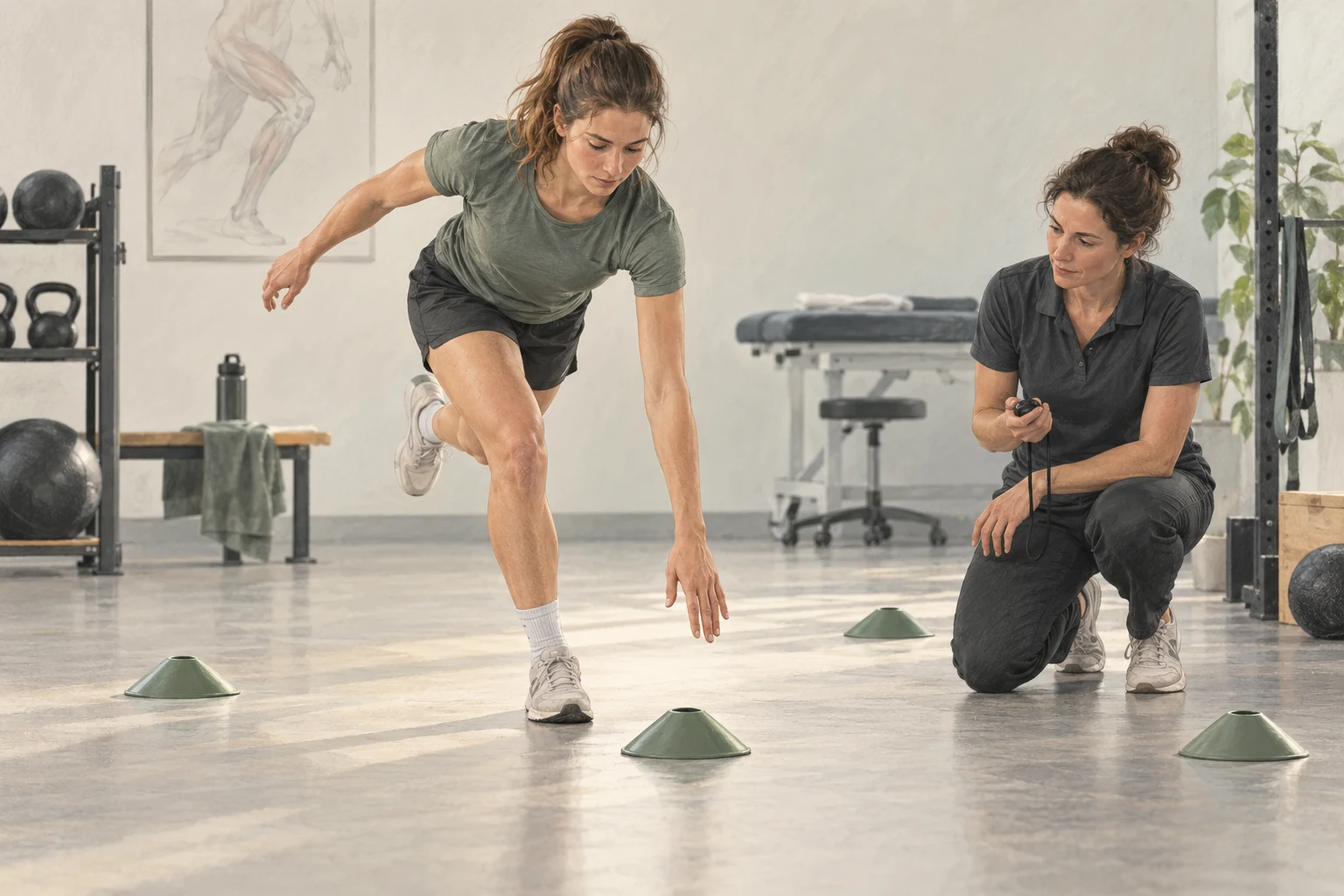
Five kilometers of walking quietly on flat ground is a different assignment than five kilometers with sprints or hills. Also within an indoor sport, the duration does not say much about the number of jumps, the speed of directional changes or the time under competition tension. Those who have symptoms from the tendons can therefore get the feeling to build carefully while several parts become heavier at the same time.
The IOC Consensus on sports load considers physical load broad: it concerns sports incentives, other physical requirements and psychological conditions. That doesn't mean that every part has to be calculated exactly. It especially helps not use a training rate as a complete summary of your week.
First, look at what you want to explain. Did the total distance go up, became the same route faster or did an extra working day come? The right question makes a simple log more useful than a set of separate data.
Start at a repeatable baseline
A starting point describes what is currently feasible, under what conditions and with what response. It's not a maximum performance test. In case of symptoms from the tendons, discuss with your clinic what activity constitutes a useful basis and what symptoms you follow. Sudden injury sometimes requires a different assessment.
A practical starting point contains three rules: the activity itself, the quantity and what you will notice later. For example, write as an example: quiet cycling on a flat route, an agreed time and then can participate in the regular evening activities. The number is chosen together; this example does not prescribe training duration.
Also record what happens outside of practice. Those who work physically have a different agenda on a working day than on vacation. The structure must be linked to an existing week, otherwise a theoretical cautious schedule becomes difficult to implement.
- Determine your starting point
Describe a repeatable activity, the amount and your response. Bring workloads, too.
- Choose what you change
Make it clear whether the next step is about duration, pace, movement, environment or planning.
- Follow the implementation
Beside pain watch how the movement goes and what you can do in daily life.
- Discuss the next step
Use the response to repeat, modify or build up; a fixed percentage is not enough.
Change focus and keep the other buttons visible
You can adjust training in different ways. The most convenient choice depends on the sport goal. For a hiking holiday longer can move is relevant; for volleyball later also jumps and unexpected actions are part of the preparation. So more minutes is not always the next logical step.
| Button | Examples | Ask for the next step |
|---|---|---|
| Quantity | Time, distance, number of sets | Is this quantity good to repeat? |
| Intensity | Move, move, move! | Does it fit more closely with the current target? |
| Motion question | Jumps, deep bending, reaching | What kind of movement is missing? |
| Environment | Hills, underground, opponent | Is the task becoming less predictable? |
| Planning | Number of sessions and distribution | Where is room for other activities? |
The overview is a call help. It predicts no injury and does not allow you to continue training in the event of unknown symptoms. Try to keep what changed clear at a planned step. This makes the reaction better to discuss than when distance, tempo and frequency increase simultaneously.
Use the response to send the call
In addition to pain, follow the execution: does the movement succeed as intended, there remains room for work and how does a recognizable daily task go afterwards? One short moment says less than a pattern under similar circumstances. Speak to the clinician when a response is acceptable, when you repeat a step and when you contact him.
A log doesn't have to be a day job. After a relevant session, note the chosen load, a striking reaction and one functional observation. For example, whether steps went differently later that day. Use the same kind of observation over and over again, so you don't constantly switch between laths.
In the event of an unexpected relapse, you can first find out what was different. That's a research question, not a search for guilt. Sometimes the explanation isn't clear. Increasing job losses or new symptoms will then require re-evaluation, not to collect more and more figures.
A sport goal consists of intermediate steps
The Bern consensus on sport resumption distinguishes between re-participants, resume the sport and find the desired level of performance. So you can already be involved in training while a full match is not yet appropriate. That intermediate phase is a full part of the plan.
Write down three different situations for your sport. In a team sport that can be an agreed exercise, part of the training and a competition task. Walking can be a short route close to home, longer terrain work and a multi-day trip. The order and feasibility are discussed individually.
Take practical pressure with you. A registration, team selection or holiday makes a purpose important, but does not in itself provide proof that you are physically ready. Please discuss in advance which alternatives are possible if the planned step does not yet succeed. That prevents the calendar from becoming the only decision-maker.
Why a fixed percentage is not a personal guarantee
A general percentage can make a scheme clear, but does not take into account all differences in starting level, sports content and symptoms. The IOC publication emphasises individual response and the importance of the context. A calculation rule can structure the conversation; it does not replace an assessment of what is actually happening.
Ask not only how much you can add, but also why that step is chosen and how it is evaluated. A useful answer identifies the purpose, execution and what you do in case of a disappointing response. In a successful step, you can sometimes repeat it before something comes along.
This makes it possible to build a series of reasoned choices. It doesn't have to be every week. A week in which the activity becomes more feasible and predictable can provide useful information for the next decision. Progress is assessed on the basis of your functioning and sports goal, without adopting a universal recovery rate.
Frequently asked questions
Is ten percent more always safe every week?
No. A fixed percentage only describes one part of the change. Tempo, movements, output level and the rest of the week may vary. Discuss which size suits your sport and how your response will be included.
Do I have to keep track of all load in an app?
Not necessarily. A short record of the activity, amount, main change and subsequent function may be enough for a discussion. Only record information that helps you decide on the next step.
Does physical work count?
Yeah, take it in the description of your week. Training is not independent of lifting, walking or working above hand. How that affects planning varies per symptom and job; discuss adjustments if necessary with the company doctor.
When will I be back in my sport?
That requires more than one good training. Take a look with your supervisor at the requirements of your sport, repeated stress, trust and competitive conditions. The step of participating to the desired level may include several intermediate phases.
Sources and evidence
- IOC-consensus: sports load and risk of injuries (2016) ↗
Wide definition of sports load, individual response and involving circumstances in load management.
- Bern-consensus: return to sport (2016) ↗
Sport resume as a continuum with context, joint decisions and multiple assessment dimensions.
A personal follow-up step
From insight
to an appropriate plan.
At a paid intake, we'll discuss your symptom and do targeted research. ultrasound is included at no extra cost when it makes sense. Any treatments are agreed separately.
View the initial consultation