A pain rate answers one question
A digit from zero to ten can help tell how severe pain feels at a time. It doesn't say directly how much tendon tissue is damaged or what a scan would show. It's not a size for what you can do that day either.
The IASP describes pain as a personal experience with physical, psychological and social influences. That description recognises that pain is meaningful and cannot be traced back to one tissue measurement. It does not prove that a concrete painful tendon is healthy; that is another question.
Therefore use the pain rate as part of a story. Specify the task you gave the figure, what preceded it, and what you could do afterwards. A pain score during a heavy task is different to interpret the same score at rest after a new injury.
Look at pain, structure and functioning separately
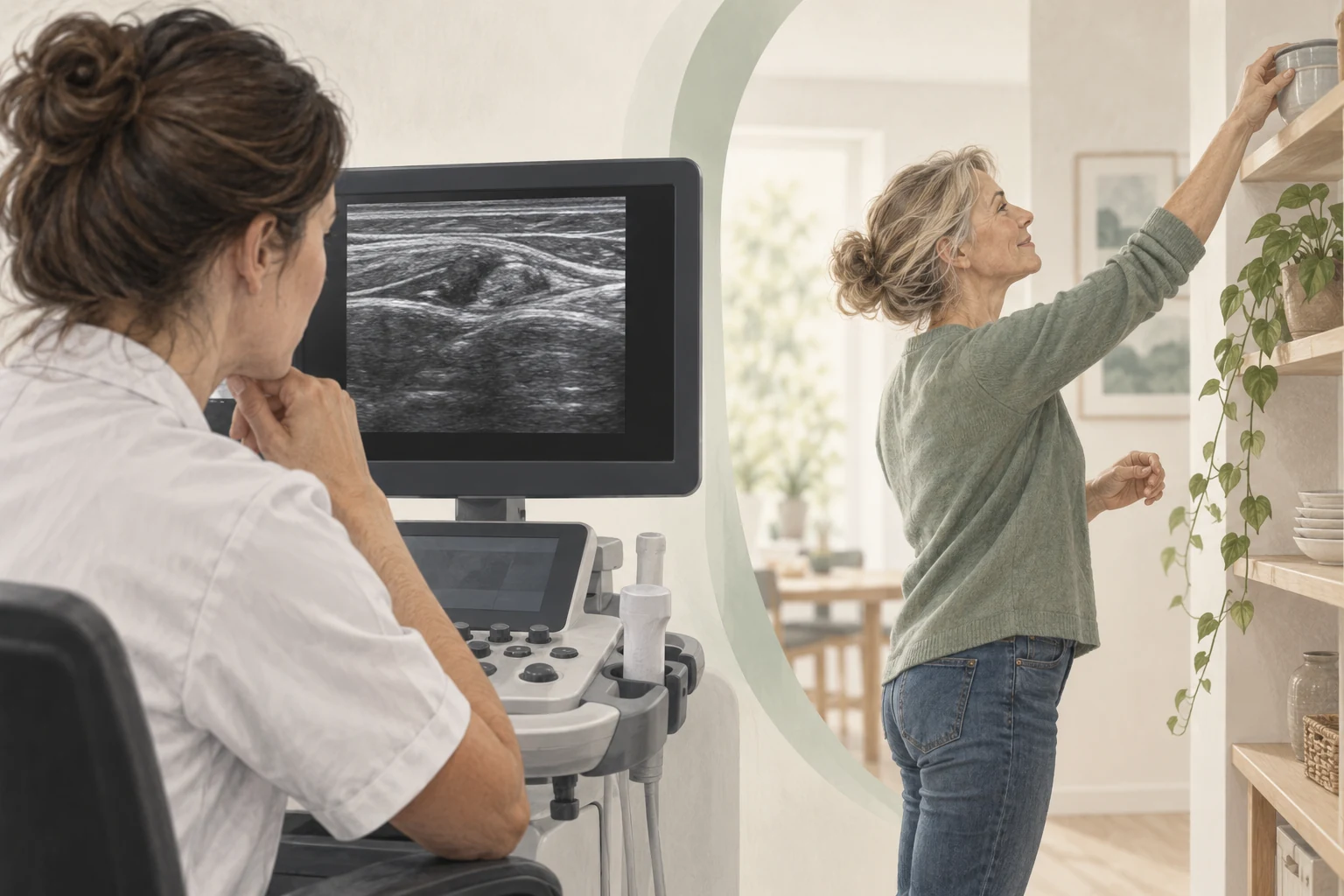
Three parts can complement each other without getting exactly the same. Pain is about the experience. Structure is about what research or imaging shows. Functionality is about movement and daily tasks. A treatment decision usually requires consistency between those parts.
In case of prolonged shoulder discomfort, describe Thuisarts that an impairment on imaging does not always explain the pain. That example is a reason to read a scan in the clinical context. It is not an argument to put aside all research findings.
A practical question with a report is therefore: does it fit my symptoms pattern and does it change the approach? A technical word can cause unrest when it is not yet clear what it means to your functioning. Ask for that translation before you draw any conclusions about what you should never do again.
Change is information, not an automatic judgment
When pain increases, it helps to describe the change. Is it the same place and the same kind of feeling? Was there a new event? Is the number especially higher, or can you really do a movement less well? These differences determine which follow-up question is important.
| What changed? | What do you tell the clinician? |
|---|---|
| Only the intensity | When and at what activity did the pain become stronger? |
| The task | Was the movement heavier, longer or different than usual? |
| The functioning | What action is less successful? |
| The symptoms Image | Is there a new place, appearance or other feeling? |
| The origins | Was there a trap, handsome or sudden moment? |
The table does not diagnose. In particular, it prevents the whole conversation from sticking to more pain. Sometimes a limited adjustment and follow-up is appropriate; sometimes the symptom needs to be re-examined. That choice depends on the overall picture.
Avoid two too definite conclusions
The conclusion all pain means damage can cause any sensitive movement to be considered a danger. The reverse conclusion pain says nothing can make relevant changes invisible. Both statements leave out important information.
For example, a sudden upper leg injury with severe loss of function or extensive blue discoloration requires a different assessment than with known varying sensitivity. Thuisarts treats the acute upper leg injury Therefore, as a separate situation. A general explanation of pain should not replace such a new incident.
Words such as wear, irritation or weak tendon are also of limited use without explanation. Ask what the Clinician means by it, on which the ruling is based and what practical consequence it has. A concrete explanation is more useful than a label that sets out all future expectations.
Compare a recognizable task
To discuss the course, you can choose one meaningful activity. For example, an agreed walking route, a domestic operation or a movement at work. Compare the same conditions as much as possible and note in addition to pain what you could perform.
One example: on two days there is equal pain, but on the second day the agreed activity succeeds with fewer interruptions. That's relevant information about functioning. It doesn't prove that the tendon structure has changed, but it does show why only the pain rate is missing part of the story.
Do not use such a comparison as a daily maximum challenge. Discuss in advance what purpose the observation has and when you judge it. If the task turns out to be inappropriate or raises new symptoms, another way of following it may be necessary. The tool should clarify the conversation and not always produce new uncertainty.
Ask for appointments that you can apply yourself
A treatment conversation becomes more useful when you know what signals you follow. Ask what can be an expected response to your diagnosis, what change contact requires and what load you have chosen together for the time being. There is no universal pain score for all tendons and all situations.
If necessary, let us explain in plain words what is known and what remains uncertain. You don't have to understand everything about pain science to have a good plan. However, it must be clear how you can carry out the appointments on your own day.
In the case of a changing image, the working diagnosis may be re-examined. In the case of a stable image, it can help to find a new explanation less often and to follow agreed functioning. The choice follows from assessment and consultation. More pain is therefore a serious signal to understand, without automatically meaning the same as more damage.
Frequently asked questions
Can a tendon hurt without a visible defect on a scan?
Pain and a scan describe several things. An image does not always explain the symptom, and the lack of a clear deviation does not make the experience unreal. The meaning depends on the story, research and the question for which the scan was made.
Can I use a pain rate to determine how much I can practice?
A figure can be part of individual agreements, but is not a universal limit for any tendon symptom. Also discuss execution, reaction later, functioning and new symptoms. Do not take over a general Internet threshold without appropriate assessment.
Does less pain mean I can do everything again?
Not automatically. A lower pain experience is pleasant, but the demands of work or sport may be greater than what you have already tried. Discuss which functional steps are needed and how to assess repeated loads.
When should more pain be re-examined?
Discuss in particular a new onset after injury, clear loss of functioning or a changed pattern of symptoms. How fast that is required depends on the symptoms. Do not use a previous diagnosis or general pain explanation to ignore new clear changes.
Sources and evidence
- IASP: revised definition of pain (2020) ↗
Pain as personal experience that cannot be reduced directly to tissue measurement.
- Thuisarts: shoulder problems for months (2024) ↗
Limitations of imaging as an explanation for prolonged shoulder pain.
- Thuisarts: sudden upper leg injury (2025) ↗
Acute upper leg injury as a different assessment situation than known gradual symptoms.
A personal follow-up step
From insight
to an appropriate plan.
At a paid intake, we'll discuss your symptom and do targeted research. ultrasound is included at no extra cost when it makes sense. Any treatments are agreed separately.
View the initial consultation