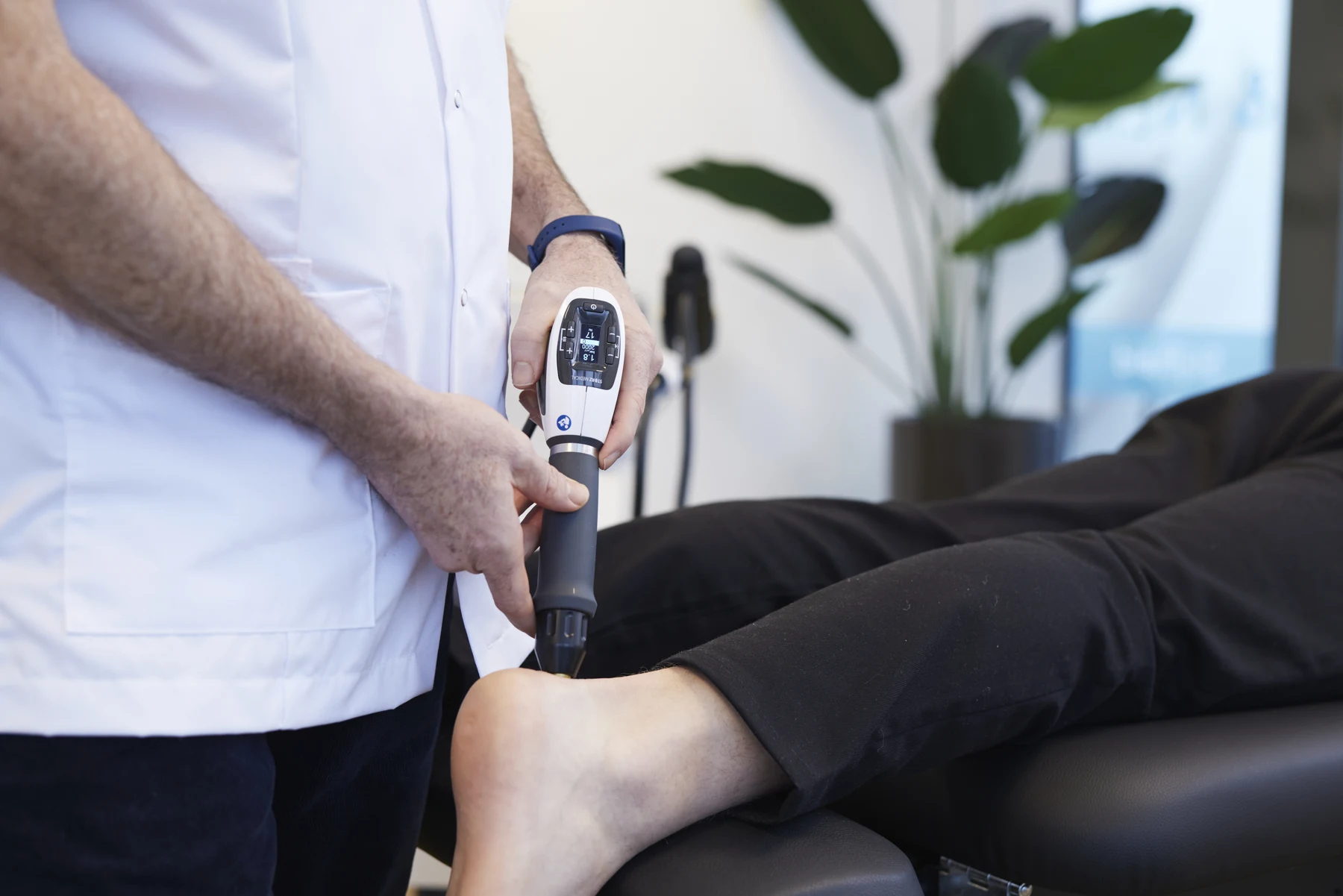
What reactions are described?
A treated area may be more sensitive after shockwave. In the Dutch guideline on fasciopathy plantar include pain, redness, swelling and bruising. These are findings in a particular application; you cannot conclude that each treatment gives the same reaction.
Make a distinction between a familiar pain that is temporarily increasing and a new symptom with a different character. A clear change in feeling, function or appearance deserves a description. It hurts more than I can hardly turn off since the treatment, and it could have.
Moreover, the fact that a reaction is known does not mean that you have to endure it indefinitely without consultation. Severity and duration also determine whether the treatment plan should be reviewed.
post-treatment soreness is not proof of better recovery
A widely heard thought is that the body must first be strongly stimulated to recover. This sometimes leads to the expectation that more post-treatment soreness is better. That reasoning does not provide a reliable way to assess a treatment outcome.
Appraisal should be about your functioning in time. Can you perform the same activity better later, keep the response manageable and move towards the agreed goal? A temporary increase in pain may occur in addition to improvement, but should not be automatically explained as a positive result.
Nor is the absence of post-treatment soreness proof that the treatment has done nothing. It is therefore more useful to register what you feel and then do so to draw a conclusion about tissue repair from every sensation.
What influences the safety balance?
The place of treatment, the technique and your medical history count. The ISMST describes safety limitations that depend on the treatment area and application. There is therefore no short list that allows you to exclude all risks without further assessment.
Tell about relevant conditions, implants, pregnancy or a possible pregnancy and medication that may affect bleeding. Also indicate if you easily get large bruises or if the feeling in the area is reduced. The controller must determine which information affects the choice.
Do not stop medication on your own initiative to allow treatment. If adjustment is found necessary, it should be discussed through the responsible prescriber. Safety is not a reason to create a different medical risk without consultation.
Record the reaction without constant monitoring
A short overview helps with contact with the clinician:
| Component | What are you writing? |
|---|---|
| Home | When did the symptom change with respect to the session? |
| Location | Is it the same place or a new area? |
| Function | What is less successful than before treatment? |
| Gradient | Is the reaction getting calmer, equal or stronger? |
| Load | What did you do after that, like work or sports? |
You don't have to test the area hard every time to see if it still hurts. Repeated provoking often gives little extra information. A few obvious observations about normal activities are more useful.
When a discoloration is visible, a photo can help for your own comparison. It doesn't replace an assessment if your symptoms are severe or increase.
When are you gonna contact me?
Contact us if the reaction is clearly stronger than discussed, unexpectedly increases or your functioning is remarkably limited. Also new sensational changes, severe swelling or extensive bruising should be discussed. Do not wait until the next scheduled session.
Sudden power loss or acute change after a good looks sensation should be assessed as a new symptom, not automatically as normal post-pain. If you have serious symptoms, you will seek medical help in time via the appropriate healthcare route. The clinician should make clear in advance how to make that choice.
In contact, describe what has changed and what you can do. A concrete report makes it easier to determine whether telephone advice is sufficient or whether an investigation is necessary.
What does a side effect mean for the follow-up?
A reaction may be a reason to adjust the execution, postpone an appointment or reconsider the treatment plan. It doesn't always have to mean that shockwave is permanently dropping. The reverse is also not self-evident because the sequence has already started.
In addition to the response, discuss the possible yield. When you notice little benefit and each treatment causes a lot of discomfort, the consideration changes. Tolerability is part of meaningful care, not an exam you have to pass.
After an adjustment, ask what response is expected and when the result is re-evaluated. Thus, the decision remains based on your development, with room to adjust the plan.
Frequently asked questions
How long can it take after pain?
For this there is no reliable general number of days that apply to any technique and condition. Please discuss in advance the expected course in your situation. A reaction that is clearly stronger, your functioning is significantly limited or feels different than explained is a reason to contact us.
Is a bruise dangerous?
A small local bruise can occur. The extent, the course and your medical situation determine whether additional assessment is necessary. Report an extensive or increasing hematoma, especially when you are taking medication that affects bleeding. Don't change the medication on your own.
Can I take painkillers after shockwave?
Discuss pain relief with your treatment or prescriber, especially when you have other medications or conditions. This article cannot determine which means suits you. Do not use post-treatment soreness as a reason to stop or replace prescribed medication without consultation.
Do I have to rest after every treatment?
A general rest requirement does not fit all symptoms. Ask what activities you can continue and what response is the reason to adjust load. The advice should be consistent with the treated area, your daily load and the purpose of the guidance.
Sources and evidence
- guideline Fasciopathy plantar – shockwave therapy (2026) ↗
Place of ESWT after education and practice therapy; effects, evaluation and adverse reactions in fasciopathy plantar.
- ISMST – Recommendations and definitions ↗
Technical differences, clinical selection and safety balances in shockwave.
A personal follow-up step
From insight
to an appropriate plan.
At a paid intake, we'll discuss your symptom and do targeted research. ultrasound is included at no extra cost when it makes sense. Any treatments are agreed separately.
View the initial consultation